Back to Journal ISO Standards

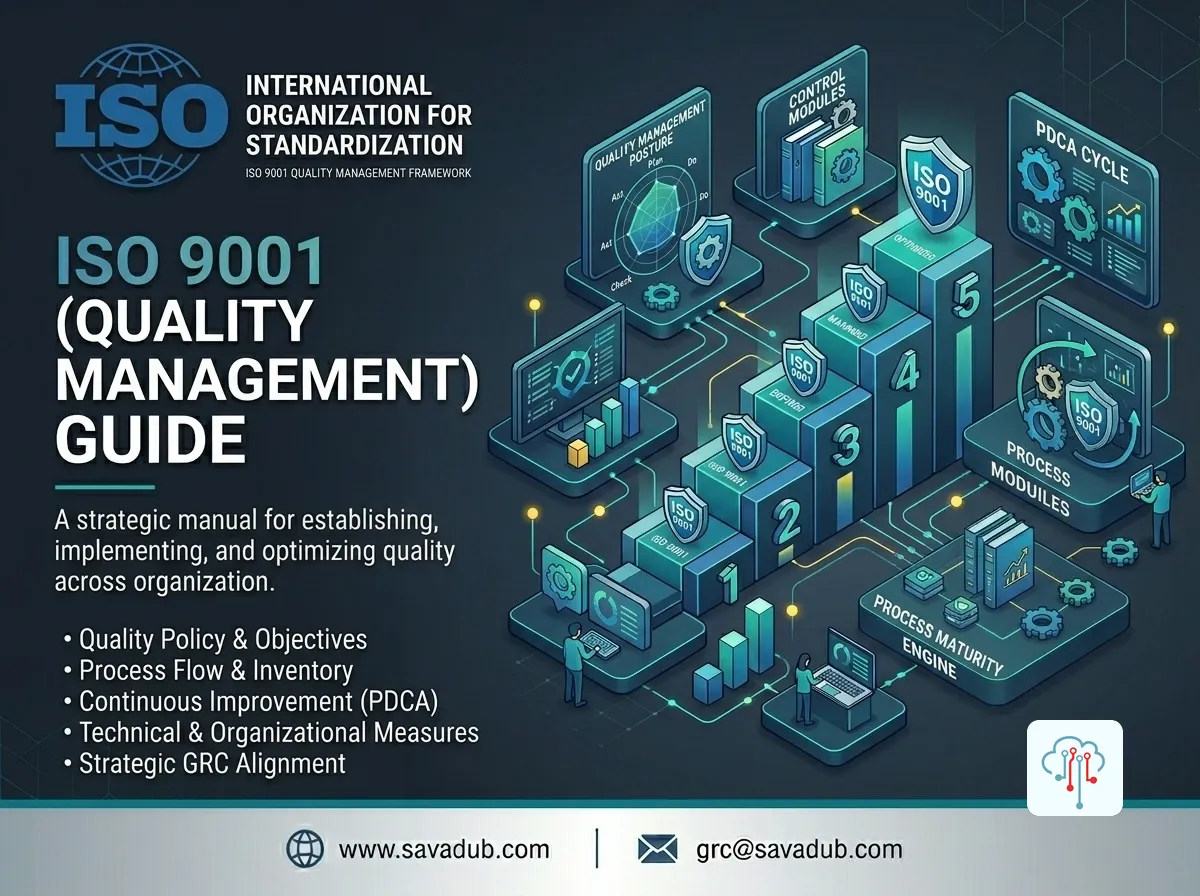
ISO 9001 - Quality Management System Certification — A Complete Business Guide

Learn how ISO 9001:2015 helps organisations build quality management systems that improve customer satisfaction, reduce waste, and meet supply chain requirements. Includes gap assessment, implementation, and audit guidance.
ISO 9001 - Quality Management System Certification — A Complete Business Guide

ISO 9001: Quality Management System — Building the Foundation for Operational Excellence

ISO 9001:2015 is the world's most widely implemented management system standard, with over one million certificates issued across 170 countries. It provides a framework for building a Quality Management System (QMS) that consistently delivers products and services meeting customer requirements, demonstrates continuous improvement, and satisfies the supply chain quality demands of enterprise customers, government buyers, and industry bodies.


The Seven Quality Management Principles

ISO 9001:2015 is built on seven quality management principles that provide the philosophical foundation of the standard:

Customer focus: Understanding current and future customer needs, meeting customer requirements, and striving to exceed expectations. Measuring customer satisfaction and using results to drive improvement.

Leadership: Leaders at all levels create conditions where people are engaged in achieving quality objectives. Top management must be personally involved in the QMS, not just delegate it.

Engagement of people: Competent, empowered, and engaged people at all levels enhance the organisation's capability to create value.

Process approach: Understanding activities as interconnected processes that function as a coherent system, producing more consistent and predictable results than managing activities in isolation.

Improvement: Continual improvement of overall performance must be a permanent objective. Organisations must respond to internal and external changes and create new opportunities.

Evidence-based decision making: Decisions based on analysis and evaluation of data and information are more likely to produce desired results.

Relationship management: Managing relationships with interested parties — suppliers, partners, customers — to optimise performance.

What ISO 9001 Requires: The Key Clauses

Context (Clause 4): Understanding the organisation's purpose, internal and external issues, interested parties, and the scope of the QMS. Risk-based thinking begins here — what internal and external factors could affect the QMS?

Leadership (Clause 5): Top management must demonstrate commitment through specific actions — establishing quality policy, assigning roles, promoting customer focus, and actively reviewing QMS performance.

Planning (Clause 6): Addressing risks and opportunities, establishing quality objectives with plans for achieving them, and planning changes to the QMS in a controlled manner.

Support (Clause 7): Resources (people, infrastructure, environment, measurement systems), competence, awareness, communication, and documented information.

Operation (Clause 8): The largest clause — covering operational planning, customer-related processes (requirements, design and development, external provision, production and service, release, and control of nonconforming outputs).

Performance Evaluation (Clause 9): Monitoring, measurement, analysis, evaluation, internal audit, and management review.

Improvement (Clause 10): Nonconformity and corrective action, and continual improvement.

ISO 9001 for Technology and Service Companies

While ISO 9001 originated in manufacturing contexts, its 2015 revision made it fully applicable to all types of organisations including pure service and technology businesses. For technology companies, key applications include:

Software development process quality: Applying ISO 9001's process approach to software development — from requirements management through design, development, testing, and deployment. The standard's requirements for design and development planning, reviews, verification, and validation map directly to software engineering practices.

Service delivery consistency: Documenting and controlling service delivery processes to ensure consistent customer experience — critical for managed service providers, consulting firms, and professional service organisations.

Customer feedback and improvement: Establishing systematic processes for gathering, analysing, and acting on customer satisfaction data. Complaint handling and correction of nonconformities are core requirements.

Supplier management: For technology companies with complex supplier and partner ecosystems, ISO 9001's externally provided processes, products, and services requirements provide a framework for supplier evaluation, selection, and monitoring.

Common ISO 9001 Audit Findings

The most frequently identified nonconformities in ISO 9001 audits include:

  • Incomplete context analysis — organisations address some internal and external issues but fail to comprehensively consider all factors affecting the QMS
  • Objectives without plans — quality objectives are defined but without documented plans specifying what will be done, who is responsible, and when results will be reviewed
  • Inadequate corrective action — problems are addressed at the symptom level without root cause analysis and without preventing recurrence
  • Customer satisfaction measurement without action — satisfaction is measured but results are not analysed and do not feed improvement activities
  • Undocumented process changes — process changes are made without the planning and review required by Clause 6.3
  • Supplier evaluation gaps — external providers are used without documented evaluation criteria or ongoing performance monitoring

Why Organisations Choose Savadub

Deep GRC Expertise

Our team holds practitioner-level expertise across every major compliance framework — not just theoretical knowledge, but hands-on implementation experience across multiple industries and organisation sizes.

Engineers, Not Just Consultants

We implement controls, not just recommend them. Our GRC engineers configure the systems, write the integrations, and build the monitoring pipelines that make compliance operational.

Global and African Regulatory Coverage

We understand both the global frameworks and the African regulatory environment — NDPR, NDPA, CBN directives, NITDA guidelines, and regional data protection laws — making us uniquely positioned for organisations operating across Africa and internationally.

Internal and External Audit Capability

We provide both embedded internal audit functions and independent third-party audit support, including CPA-accredited audit coordination for SOC examinations.

End-to-End Engagement

From initial gap assessment through certification, continuous monitoring, and ongoing compliance management — we are your long-term GRC partner, not a one-time consultant.

Industries We Serve

Financial Services · Healthcare · Technology & SaaS · Manufacturing · Logistics & Trade · Government & Public Sector · Energy & Critical Infrastructure · Education & EdTech · Media & Broadcasting · Retail & E-Commerce · Professional Services · Food & Beverage

Deliverables You Receive

Working with Savadub, every engagement delivers a concrete set of outputs:

  • Gap Assessment Report — prioritised findings with effort estimates and risk ratings
  • Compliance Roadmap — milestone-based plan from current state to certification or attestation
  • Risk Register — organisational risk register with treatment plans
  • Policy Pack — all required policies authored, reviewed, and approved
  • Technical Control Implementation Evidence — configurations, screenshots, and audit trails
  • Internal Audit Report — independent assessment of control effectiveness
  • Audit Evidence Repository — organised, auditor-ready evidence collection
  • Executive Summary Presentation — board and leadership-ready compliance status
  • Remediation Tracker — structured tracking of open findings and closure evidence
  • Continuous Monitoring Setup — ongoing CCM pipeline for post-certification compliance

Get Started with Savadub

Savadub's GRC practice combines deep compliance expertise with technical engineering capability. We don't just advise — we build, implement, and operate your compliance program from the ground up.

Book a free GRC consultation with our team. We will review your current posture, identify your most critical gaps, and give you a clear, costed roadmap to compliance.

Contact us:

  • Email: grc@savadub.com
  • Phone: +234 816 734 2201
  • WhatsApp: +234 903 234 8435
  • Website: www.savadub.com

Share this story