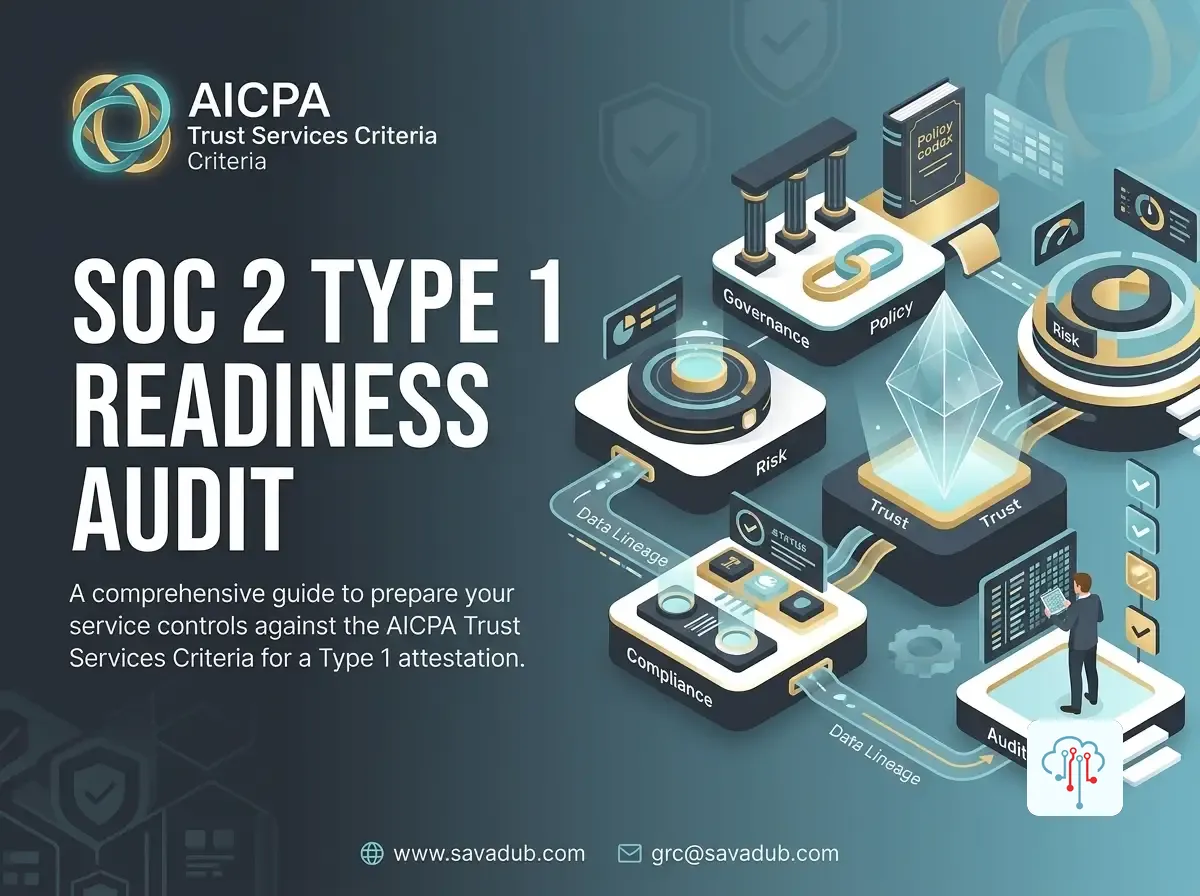
SOC 2 Type I Compliance: Everything You Need to Know to Get Audit-Ready Fast
If your sales team is losing deals because enterprise prospects are asking for a SOC 2 report you don't have, you are not alone. SOC 2 has become the de facto security assurance standard for technology companies, SaaS platforms, cloud service providers, and any organisation that processes customer data on behalf of other businesses. Without it, enterprise procurement doors remain closed regardless of how good your product is.
This guide covers everything decision-makers, engineering leads, compliance managers, and founders need to know about SOC 2 Type I — what it is, how it differs from Type II, what the readiness journey looks like, what auditors actually examine, and how to reach attestation without losing months of engineering velocity.
What Is SOC 2?
SOC 2 stands for System and Organisation Controls 2. It is an auditing standard developed by the American Institute of Certified Public Accountants (AICPA) specifically for service organisations — companies that store, process, or transmit customer data as part of delivering a service.
Unlike ISO 27001, which is a certifiable management system standard, SOC 2 results in an attestation report issued by a licensed CPA firm. The report expresses an independent auditor's opinion on whether your organisation's controls are suitably designed (Type I) or operating effectively over time (Type II).
SOC 2 is built around five Trust Services Criteria (TSC):
- Security (mandatory) — protection of systems and data from unauthorised access
- Availability — system availability and performance as committed
- Processing Integrity — complete, accurate, timely, and authorised processing
- Confidentiality — protection of information designated as confidential
- Privacy — collection, use, retention, and disposal of personal information
Most organisations pursue Security as the baseline. Availability and Confidentiality are commonly added. Processing Integrity applies to organisations like payment processors or data transformation services. Privacy is relevant for companies handling significant volumes of personal data.
SOC 2 Type I vs. Type II: What Is the Difference?
This is the most common question organisations ask when beginning their SOC 2 journey, and the distinction matters significantly for planning purposes.
SOC 2 Type I assesses whether your controls are suitably designed at a single point in time. The auditor examines your control documentation, system descriptions, and policies to determine whether the controls you have in place are logically capable of meeting the Trust Services Criteria. It is essentially a design-effectiveness assessment — a point-in-time snapshot.
SOC 2 Type II assesses whether those controls were operating effectively over a defined observation period — typically six to twelve months. The auditor tests whether the controls actually worked consistently throughout that period by examining evidence, logs, tickets, access reviews, and other operational artifacts.
For most organisations starting their SOC 2 journey, Type I is the right first step because:
- It can typically be achieved in eight to fourteen weeks
- It demonstrates to enterprise customers that controls are in place and properly designed
- It establishes the control baseline from which Type II observation begins
- It is significantly faster and less evidence-intensive than Type II
Many enterprise procurement teams will accept a Type I report while you pursue Type II, especially when combined with a clear timeline for Type II completion. However, increasingly sophisticated buyers — particularly in financial services, healthcare, and the public sector — require Type II specifically.
Who Needs SOC 2 Type I?
SOC 2 is relevant to any organisation that:
- Provides software as a service (SaaS) to other businesses
- Processes customer data as part of service delivery
- Hosts infrastructure for other organisations (cloud providers, managed service providers, data centres)
- Handles sensitive data including financial records, health information, or personal data on behalf of clients
- Operates in supply chains where downstream customers require vendor security assurance
Industries where SOC 2 Type I is most commonly required or requested include:
- Technology and SaaS — enterprise sales almost universally require it
- Financial services — for service organisations impacting financial reporting or processing payments
- Healthcare technology — particularly when paired with HIPAA compliance
- Human resources and payroll platforms — handling sensitive employee data
- Legal technology — managing privileged and confidential client information
- Marketing and data platforms — processing behavioural and demographic data at scale
If your organisation sells to mid-market or enterprise accounts in North America, Europe, or increasingly in the Middle East and Africa, you will encounter SOC 2 requirements. It is not a matter of if — it is a matter of when.
The Five Trust Services Criteria in Depth
1. Security (Common Criteria)
Security is the only mandatory Trust Services Criterion. The AICPA's Common Criteria — formerly CC1 through CC9 — cover:
- Control environment — governance, risk management, accountability structures
- Communication and information — how security information flows internally and externally
- Risk assessment — identifying and analysing relevant risks
- Monitoring — ongoing assessment of whether controls are functioning
- Logical and physical access controls — who can access what, and how that access is provisioned, reviewed, and revoked
- System operations — change management, incident response, vulnerability management
- Change management — how changes to systems are authorised, tested, and deployed
2. Availability
If you commit to uptime SLAs in customer contracts, Availability is almost certainly relevant to your SOC 2 scope. Controls include:
- Capacity planning and monitoring
- Incident response procedures affecting availability
- Backup and recovery processes
- Business continuity and disaster recovery plans
3. Confidentiality
Confidentiality covers how you protect information that has been designated confidential — typically under NDA, contract, or regulatory obligation. Controls include:
- Data classification policies and procedures
- Encryption in transit and at rest for confidential data
- Confidentiality agreements with employees and sub-processors
- Secure disposal of confidential information
4. Processing Integrity
Applicable to organisations where the accuracy and completeness of processing is material — payment processors, data analytics platforms, financial technology. Controls include:
- Input validation and error handling
- Processing completeness checks
- Output reconciliation procedures
- Error correction and logging
5. Privacy
Privacy under SOC 2 aligns to AICPA's Generally Accepted Privacy Principles (GAPP) and is more relevant for organisations handling consumer personal information at scale. Controls address:
- Notice and consent for collection
- Data subject rights procedures
- Retention and disposal schedules
- Third-party disclosure governance
The SOC 2 Type I Readiness Journey
Achieving SOC 2 Type I attestation is a structured process. Here is what each phase involves.
Phase 1: Scoping (Weeks 1–2)
Scoping defines the boundary of what the audit will cover. This includes:
- Identifying the system description — the services, infrastructure, software, people, and processes in scope
- Selecting Trust Services Criteria — which of the five criteria apply to your business and customer commitments
- Identifying in-scope infrastructure — cloud accounts, databases, code repositories, HR systems, identity providers
- Mapping data flows — where customer data enters, moves through, and exits your systems
Scoping decisions have significant downstream implications. Scope that is too broad makes the audit unnecessarily burdensome. Scope that is too narrow may not satisfy sophisticated enterprise buyers. Getting this right early saves significant effort.
Phase 2: Gap Assessment (Weeks 2–4)
The gap assessment maps your current controls against the Trust Services Criteria requirements and identifies what is missing, insufficient, or undocumented. A structured gap assessment produces:
- A control matrix showing each TSC requirement against your current state
- A prioritised list of gaps by severity and effort to remediate
- An effort estimate for reaching readiness
- A compliance roadmap with clear milestones
Common gaps found at this stage include absence of formal access review processes, missing security awareness training records, undocumented change management procedures, and lack of formal vendor management policies.
Phase 3: Remediation (Weeks 3–8)
Remediation involves closing the gaps identified in the assessment. This work falls into two categories:
Administrative remediation:
- Authoring missing policies (information security policy, access control policy, change management policy, incident response plan, risk assessment procedure, vendor management policy, acceptable use policy)
- Creating process documentation
- Establishing governance meetings and cadences
- Implementing security awareness training programmes
Technical remediation:
- Configuring multi-factor authentication across all in-scope systems
- Implementing privileged access management
- Enabling and centralising logging
- Configuring vulnerability scanning
- Implementing encryption controls
- Establishing backup and recovery procedures
Phase 4: System Description Development (Weeks 6–8)
The System Description is a critical audit deliverable — a formal narrative document that describes:
- The services you provide and the nature of your system
- The boundaries of the system in scope
- The principal service commitments and system requirements
- The components of the system (infrastructure, software, people, procedures, data)
- How the Trust Services Criteria are addressed by your controls
- Any subservice organisations (cloud providers, identity providers, payment processors) and their complementary controls
The System Description is reviewed by the auditor and becomes part of the final SOC 2 report. It must be accurate, complete, and consistent with your actual controls.
Phase 5: Pre-Audit Readiness Review (Week 8–10)
Before engaging the auditor for the formal examination, a readiness review confirms that:
- All identified gaps have been remediated
- Policy documentation is complete and approved
- Technical controls are in place and configured correctly
- The System Description is accurate
- Evidence collection processes are working
- Your team understands what auditors will ask and where evidence lives
Phase 6: Auditor Examination (Weeks 10–14)
The CPA firm conducts the Type I examination. For Type I, auditors:
- Review the System Description for completeness and accuracy
- Inspect control documentation (policies, procedures, configuration evidence)
- Conduct walkthroughs with key personnel
- Verify that controls described in the System Description exist as described
- Assess whether the design of controls is suitable to achieve the Trust Services Criteria
This is not a pass/fail examination — the auditor expresses an opinion. The most desirable outcome is an unqualified opinion, meaning the auditor found the controls suitably designed with no material exceptions. Qualified opinions indicate exceptions that management must address.
Phase 7: Report Issuance and Response (Weeks 14–16)
The final SOC 2 Type I report contains:
- The independent auditor's opinion
- Management's assertion
- The System Description
- A description of the tests performed and results
- Any exceptions noted
If exceptions are noted, management responses are included. Following report issuance, most organisations immediately begin the Type II observation period — which starts when controls are fully operational.
What SOC 2 Auditors Actually Look For
Understanding the auditor's perspective helps organisations prepare more effectively.
Auditors are looking for evidence of design at the Type I stage. This means:
- Written policies that are formally approved, dated, and assigned ownership
- Control procedures that are documented and reflect actual practice
- Technical configurations that implement what the policies prescribe
- Organisational roles and responsibilities that are clearly defined
- A risk assessment process that identifies and prioritises relevant risks
- Governance structures — security committee, risk reviews — that provide oversight
Common Type I audit findings include:
- Policies that reference practices that don't actually exist yet
- Access control policies that don't match actual access provisioning procedures
- Missing risk assessment documentation
- Vendor management policies without a corresponding vendor inventory
- Incident response plans that have never been tested or reviewed
- Encryption policies that are contradicted by actual system configurations
Evidence You Will Need to Collect
Even for Type I, auditors will request inspection of certain evidence to confirm controls exist as described:
- Policy documents with version history and approval signatures
- Organisation charts and role descriptions
- Access control configurations (screenshots, exports from identity providers)
- Encryption configurations
- Vulnerability scan configurations and recent outputs
- Security awareness training programme materials and completion records
- Vendor lists and vendor assessment documentation
- Incident response procedure documentation
- Change management process documentation
- Business continuity and disaster recovery plan
SOC 2 Type I Costs and Timelines
Timeline: Eight to fourteen weeks from project kickoff to report issuance is achievable for most organisations with dedicated focus. Organisations with significant remediation gaps may need sixteen to twenty weeks.
Audit fees: CPA firm fees for SOC 2 Type I typically range from $15,000 to $40,000 USD depending on scope complexity, organisation size, and the number of Trust Services Criteria included. This is the auditor fee only — separate from readiness support.
Readiness support: Working with a GRC partner for readiness preparation typically adds $10,000 to $30,000 but significantly increases the probability of a clean report and reduces the time to readiness.
Common cost drivers:
- Number of Trust Services Criteria in scope
- Number of in-scope systems and cloud accounts
- Number of employees and contractors
- Complexity of subservice organisation landscape
- Volume of remediation work required
SOC 2 Type I Common Pitfalls
1. Underestimating the policy workload
Many organisations have informal practices but no documented policies. Writing, reviewing, and approving fifteen to twenty policies takes significant time. Starting this work early is critical.
2. Scope creep
Adding systems, criteria, or services to scope mid-engagement increases cost and timelines significantly. Define scope carefully and protect it.
3. Treating SOC 2 as an IT project
SOC 2 touches HR (background checks, training), legal (vendor contracts, NDAs), finance (access controls over financial systems), and operations. Executive sponsorship and cross-functional involvement are essential.
4. Not understanding subservice organisation responsibilities
If you use AWS, Azure, GCP, or Salesforce, these are subservice organisations. Your System Description must address how their controls complement yours — and you need User Entity Controls (UECs) defined for what your customers must do.
5. Choosing the wrong CPA firm
SOC 2 audits must be performed by licensed CPA firms. Choosing an auditor without deep SOC 2 experience leads to slow examinations, excessive evidence requests, and findings that could have been avoided with better preparation.
SOC 2 Type I vs. Other Security Frameworks
| Framework | Type | Output | Best For |
|---|---|---|---|
| SOC 2 Type I | Attestation (point-in-time) | Audit report | SaaS, service orgs, enterprise sales |
| SOC 2 Type II | Attestation (period) | Audit report | Enterprise sales, higher assurance |
| ISO 27001 | Certification | Certificate | Global market, EU, government |
| NIST CSF | Framework | Assessment | US federal, internal maturity |
| PCI DSS | Compliance | AOC/ROC | Payment card processing |
Maintaining Your SOC 2 Posture After Type I
Type I is not the end of your SOC 2 journey — it is the beginning. Immediately after achieving Type I, you should:
- Begin Type II observation — ensure all controls are operating as designed from day one
- Establish evidence collection routines — weekly or monthly collection of access reviews, change tickets, training records
- Schedule quarterly control reviews — identify and remediate any control failures promptly
- Update policies annually — or whenever your system, processes, or personnel change materially
- Communicate your SOC 2 status to prospects — share the report under NDA as a sales asset
Why Organisations Choose Savadub for SOC 2 Type I
Savadub's GRC practice combines compliance expertise with technical engineering — meaning we don't just advise on what controls to implement, we implement them. Our SOC 2 Type I engagement delivers:
- Scoped readiness assessment with a prioritised gap report in the first two weeks
- Full policy library authoring — fifteen to twenty policies written, reviewed, and ready for approval
- Technical control implementation — MFA, logging, vulnerability scanning, access management configured and evidenced
- System Description drafting — the document that becomes the heart of your audit report
- CPA auditor coordination — we manage the auditor relationship, answer questions, and prepare your team
- Clean report focus — our pre-audit review process is designed to catch and close every finding before the auditor sees it
Whether you are a twelve-person startup trying to close your first enterprise contract or a two-hundred-person SaaS company preparing for a funding round, we structure the engagement to move at your pace without disrupting your product team.
Deliverables You Receive
Working with Savadub on SOC 2 Type I, you receive:
- Gap assessment report with prioritised findings and effort estimates
- Compliance roadmap with milestone dates
- Complete policy library (15–20 policies tailored to your organisation)
- Risk register with initial risk assessment
- System Description document (draft and final)
- Technical control implementation evidence
- Pre-audit readiness review report
- Audit coordination and management throughout the CPA examination
- SOC 2 Type I report (issued by CPA firm)
- Remediation tracker for any exceptions noted
- Type II preparation briefing and observation period setup
Frequently Asked Questions
Can we go straight to SOC 2 Type II without doing Type I first? Yes. Many organisations skip Type I and go directly to Type II, particularly when they have adequate time for a full observation period and enterprise customers specifically require Type II. However, Type I provides a useful intermediate milestone and allows you to start sharing a report with customers sooner.
How long is a SOC 2 Type I report valid? There is no formal expiry, but most enterprise buyers consider a SOC 2 Type I report stale after twelve months. Type II reports covering more recent periods are generally preferred by sophisticated buyers.
Does SOC 2 cover our entire company or just specific products? SOC 2 scope is defined at the system level, not the company level. You can scope a SOC 2 report to a specific product, service, or platform rather than your entire organisation — this is often the most practical approach for organisations with multiple product lines.
What happens if the auditor finds exceptions? Exceptions are noted in the report along with management responses. A Type I report with minor exceptions is still commercially useful — buyers evaluate the nature and severity of exceptions, not just their presence. Material exceptions should be remediated and addressed in subsequent audits.
Get Started with SOC 2 Type I
If enterprise customers are asking for your SOC 2 report, every month without it is a month of deals delayed or lost. Savadub's SOC 2 Type I engagement is designed to get you to attestation in the shortest responsible timeline — with clean controls, complete documentation, and a report that satisfies the most demanding enterprise procurement teams.
Book a free SOC 2 readiness consultation with our GRC team. We will review your current security posture, identify your biggest gaps, and give you a realistic timeline and roadmap to Type I attestation.
Contact us:
- Email: grc@savadub.com
- Phone: +234 816 734 2201
- WhatsApp: +234 903 234 8435
- Website: www.savadub.com