Secure SDLC: Integrating Security Into Every Phase of Software Development
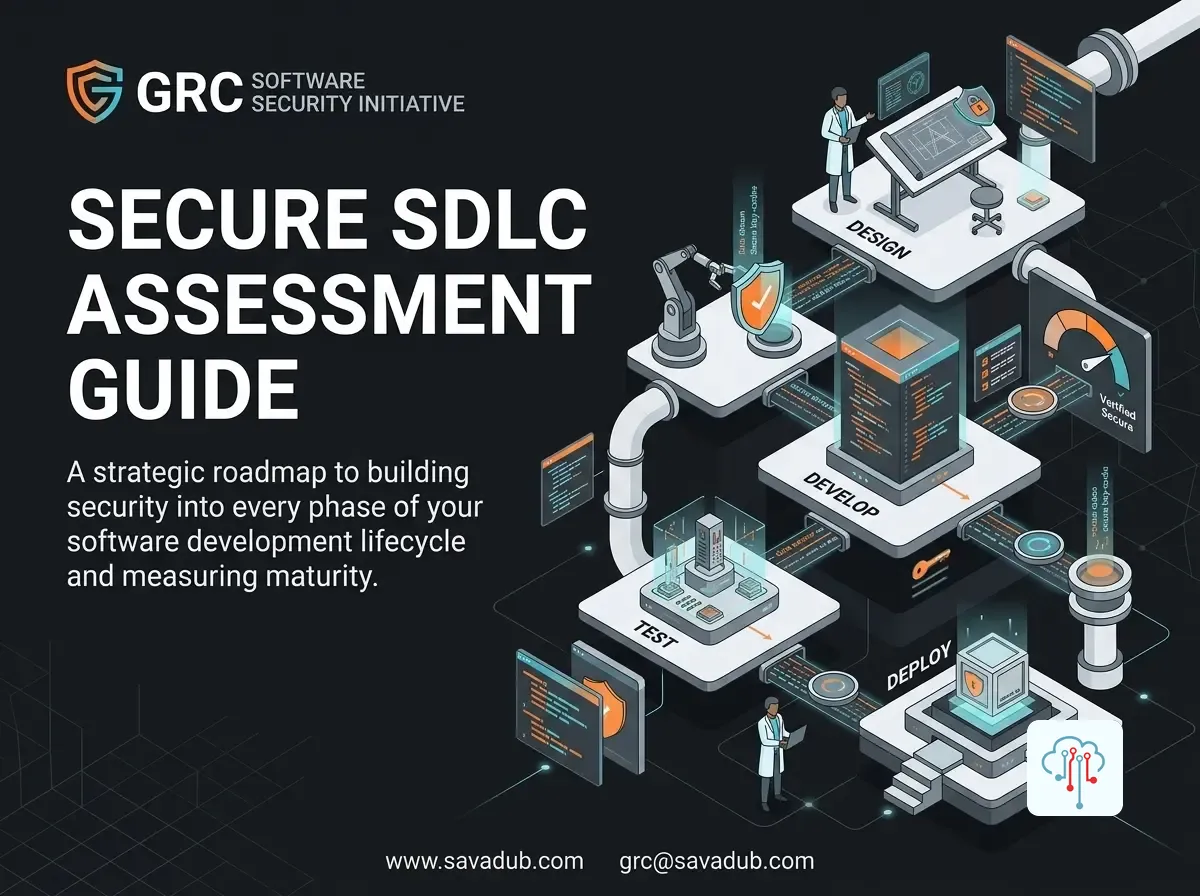
Security vulnerabilities are almost always cheaper to fix during development than after deployment. A buffer overflow caught in code review costs minutes to fix. The same vulnerability discovered in production — or worse, exploited by an attacker — costs hundreds of thousands of dollars in incident response, legal liability, and reputational damage. The Secure Software Development Lifecycle (Secure SDLC) is the discipline of systematically integrating security activities into every phase of software development so that security is built in rather than bolted on.
Security Requirements Phase
Security must begin before a line of code is written. During requirements definition, security requirements are identified and documented alongside functional requirements:
Compliance requirements: Which regulations and standards apply to this system? GDPR? HIPAA? PCI DSS? What specific technical requirements do they impose?
Authentication and authorisation requirements: Who uses this system? What roles exist? What data can each role access? What level of authentication strength is required?
Data classification and handling: What categories of data will the system process? What encryption, masking, retention, and deletion requirements apply?
Security SLAs: What availability, integrity, and confidentiality commitments must the system meet?
Abuse case analysis: Beyond standard use cases, what misuse scenarios must the system defend against?
Threat Modelling: The Security Design Review
Threat modelling is the systematic identification and prioritisation of threats to a system during design — before implementation begins. The most widely used methodology is STRIDE:
- Spoofing: Can an attacker impersonate a legitimate user or system component?
- Tampering: Can data in transit or at rest be modified without detection?
- Repudiation: Can users deny performing actions they actually performed?
- Information Disclosure: Can unauthorised parties access sensitive data?
- Denial of Service: Can the system be made unavailable?
- Elevation of Privilege: Can a lower-privileged user gain higher-privileged access?
Threat modelling produces a prioritised list of threats and the security controls selected to mitigate them — directly informing the technical design of the system.
Static Application Security Testing (SAST) in CI/CD
SAST analyses source code, bytecode, or binary code without executing the application, identifying security vulnerabilities in the codebase. Integrating SAST into the CI/CD pipeline creates a security gate that prevents vulnerable code from progressing through the pipeline.
What SAST finds: SQL injection patterns, command injection, path traversal, XSS, hardcoded secrets, insecure cryptographic API usage, unsafe deserialization, and many OWASP Top 10 categories.
SAST tools: Commercial (Veracode, Checkmarx, SonarQube Enterprise) and open source (Semgrep, Bandit for Python, SpotBugs for Java) options. Most modern CI/CD platforms have native integrations.
Managing false positives: SAST tools produce false positives that must be triaged and suppressed. Establish a triage process that routes real findings to the development team for remediation and documents suppression decisions with justification.
Dynamic Application Security Testing (DAST) and Penetration Testing
DAST tests the running application by sending malicious inputs and analysing responses — simulating an external attacker with no knowledge of the source code. DAST finds vulnerabilities that only manifest at runtime:
What DAST finds: Authentication bypasses, session management flaws, injection vulnerabilities, broken access control, SSRF, and configuration issues visible in HTTP responses.
Integration approach: DAST can be integrated into CI/CD pipelines using API-driven scanners (OWASP ZAP, Burp Suite Enterprise) for automated scanning of staging environments. Full authenticated scans with comprehensive coverage are typically run on a scheduled basis rather than every commit.
Penetration testing: Annual or bi-annual manual penetration testing by skilled security professionals finds vulnerabilities that automated tools miss — particularly business logic flaws, chained attack scenarios, and novel vulnerability patterns.
Software Composition Analysis: Managing Dependency Risk
Modern applications are typically 70-90% third-party code — libraries, frameworks, and packages from npm, pip, Maven, and other package repositories. Every dependency is a potential vulnerability source.
Software Composition Analysis (SCA) automatically inventories your dependencies and checks them against vulnerability databases (NVD, GitHub Advisory Database, OSV) to identify known CVEs in your dependency tree.
Integration: SCA tools (Snyk, OWASP Dependency-Check, GitHub Dependabot) integrate into CI/CD pipelines and IDEs, providing real-time vulnerability alerts and suggested remediation (typically version upgrades).
Software Bill of Materials (SBOM): Generating and maintaining an SBOM — a formal record of all dependencies and their versions — is increasingly required by enterprise customers and regulators as a supply chain security measure.
Why Organisations Choose Savadub
Deep GRC Expertise
Our team holds practitioner-level expertise across every major compliance framework — not just theoretical knowledge, but hands-on implementation experience across multiple industries and organisation sizes.
Engineers, Not Just Consultants
We implement controls, not just recommend them. Our GRC engineers configure the systems, write the integrations, and build the monitoring pipelines that make compliance operational.
Global and African Regulatory Coverage
We understand both the global frameworks and the African regulatory environment — NDPR, NDPA, CBN directives, NITDA guidelines, and regional data protection laws — making us uniquely positioned for organisations operating across Africa and internationally.
Internal and External Audit Capability
We provide both embedded internal audit functions and independent third-party audit support, including CPA-accredited audit coordination for SOC examinations.
End-to-End Engagement
From initial gap assessment through certification, continuous monitoring, and ongoing compliance management — we are your long-term GRC partner, not a one-time consultant.
Industries We Serve
Financial Services · Healthcare · Technology & SaaS · Manufacturing · Logistics & Trade · Government & Public Sector · Energy & Critical Infrastructure · Education & EdTech · Media & Broadcasting · Retail & E-Commerce · Professional Services · Food & Beverage
Deliverables You Receive
Working with Savadub, every engagement delivers a concrete set of outputs:
- Gap Assessment Report — prioritised findings with effort estimates and risk ratings
- Compliance Roadmap — milestone-based plan from current state to certification or attestation
- Risk Register — organisational risk register with treatment plans
- Policy Pack — all required policies authored, reviewed, and approved
- Technical Control Implementation Evidence — configurations, screenshots, and audit trails
- Internal Audit Report — independent assessment of control effectiveness
- Audit Evidence Repository — organised, auditor-ready evidence collection
- Executive Summary Presentation — board and leadership-ready compliance status
- Remediation Tracker — structured tracking of open findings and closure evidence
- Continuous Monitoring Setup — ongoing CCM pipeline for post-certification compliance
Get Started with Savadub
Savadub's GRC practice combines deep compliance expertise with technical engineering capability. We don't just advise — we build, implement, and operate your compliance program from the ground up.
Book a free GRC consultation with our team. We will review your current posture, identify your most critical gaps, and give you a clear, costed roadmap to compliance.
Contact us:
- Email: grc@savadub.com
- Phone: +234 816 734 2201
- WhatsApp: +234 903 234 8435
- Website: www.savadub.com