Back to Journal NIST Standards

NIST AI Risk Management Framework - Managing AI Risks with the AI RMF 1.0

A practical guide to the NIST AI Risk Management Framework (AI RMF 1.0) — the four core functions, how to apply them to AI system development and deployment, and how AI RMF aligns with the EU AI Act and emerging AI governance requirements.
NIST AI Risk Management Framework - Managing AI Risks with the AI RMF 1.0

NIST AI Risk Management Framework: Building Trustworthy AI Through Structured Risk Management

Artificial intelligence systems introduce categories of risk that traditional cybersecurity and operational risk frameworks were not designed to address — bias and fairness risks, explainability challenges, unpredictable behaviour, and systemic societal impacts at scale. The NIST AI Risk Management Framework (AI RMF 1.0), released in January 2023, provides voluntary guidance for managing these risks throughout the AI system lifecycle. As AI governance becomes a regulatory reality — with the EU AI Act now in force — AI RMF provides the operational framework for demonstrating responsible AI development and deployment.


The Four Core Functions: GOVERN, MAP, MEASURE, MANAGE

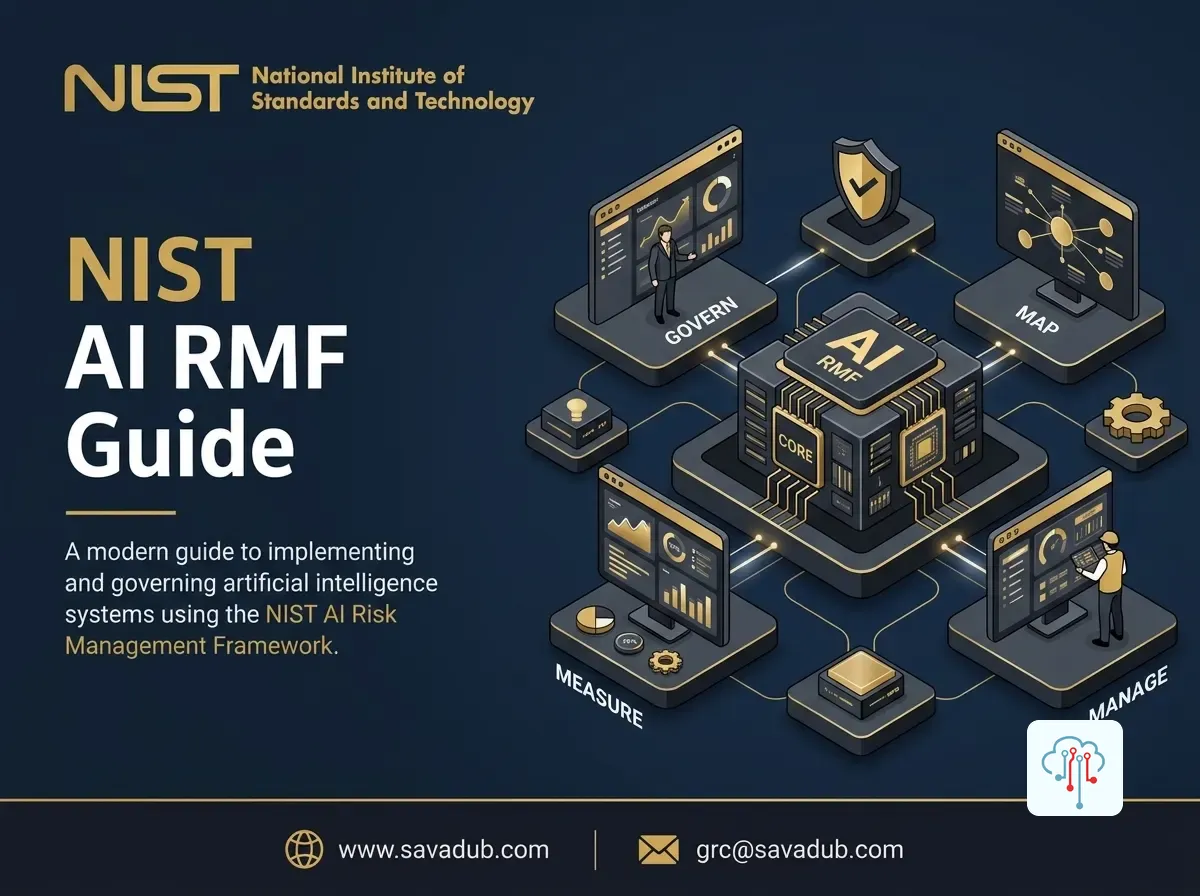
GOVERN: Establishes the organisational context for AI risk management — culture, policies, accountability structures, risk appetite, and the processes that enable the other three functions. Governance includes establishing AI policies, defining roles for AI risk oversight, ensuring workforce competence in AI risk, and integrating AI risk into enterprise risk management.

MAP: Identifies and categorises AI risks in context. This function establishes context for the AI system — its intended purpose, deployment context, users, affected communities, and potential negative impacts. Risk mapping covers technical risks (accuracy, robustness, security) and non-technical risks (bias, privacy, societal harm).

MEASURE: Applies methods to analyse and assess AI risks. Measurement includes testing, evaluation, and monitoring of AI systems using quantitative and qualitative techniques appropriate to the system's risk level and context. The MEASURE function covers explainability assessment, bias testing, adversarial robustness evaluation, and performance monitoring.

MANAGE: Prioritises and addresses AI risks based on the outputs of MAP and MEASURE. This includes risk treatment decisions, allocation of resources to risk reduction, incident response for AI-related failures, and feedback loops to the GOVERN and MAP functions.

The Seven Properties of Trustworthy AI

The AI RMF is built around seven characteristics of trustworthy AI systems:

Accuracy: The AI system produces correct outputs for its intended use. Accuracy must be assessed across diverse user populations and deployment contexts.

Explainability and Interpretability: Stakeholders can understand how the AI system produces its outputs. The level of explainability required depends on the stakes of the decisions the system informs or makes.

Privacy: The AI system protects individuals' privacy throughout the data lifecycle — collection, processing, model training, and output generation.

Reliability and Robustness: The system performs as intended across a range of operational conditions, including unexpected inputs and adversarial attacks.

Safety: The system does not cause unacceptable physical, psychological, or societal harm to users, operators, or third parties.

Security and Resilience: The system resists manipulation, adversarial attacks, and unintended behaviour caused by security vulnerabilities.

Bias Management and Fairness: The system does not produce systematically unfair outcomes for specific demographic groups, and bias risks are identified, measured, and mitigated.

AI RMF and the EU AI Act

The EU AI Act, which entered into force in 2024 and began applying from 2025, is the world's first comprehensive AI regulation. While different in approach (NIST AI RMF is voluntary; EU AI Act is mandatory), they are highly complementary.

EU AI Act risk categories:

  • Unacceptable risk: Prohibited AI systems (social scoring, cognitive manipulation)
  • High risk: AI in critical infrastructure, education, employment, essential services, law enforcement — requiring conformity assessment, documentation, human oversight, accuracy, and robustness requirements
  • Limited risk: Transparency obligations (chatbots must identify as AI)
  • Minimal risk: No specific requirements

NIST AI RMF's GOVERN, MAP, MEASURE, and MANAGE functions provide an operational framework for implementing the EU AI Act's requirements for high-risk AI systems — particularly the requirements for risk management systems (Article 9), data governance (Article 10), technical documentation (Article 11), and human oversight (Article 14).

Implementing AI RMF in Practice

AI system inventory: Before applying the AI RMF, organisations must know what AI systems they operate — including embedded AI in third-party software, AI used in hiring or credit decisions, and AI tools used by employees.

Risk classification: Each AI system should be classified by its risk level based on the potential for harm — the stakes of the decisions it informs, the size and diversity of affected populations, the degree of human oversight, and the reversibility of harms.

Cross-functional governance: AI risk management requires collaboration across functions that don't traditionally work together — data science, legal, compliance, ethics, product, and operations. The GOVERN function establishes the structures for this collaboration.

Ongoing monitoring: AI systems degrade over time as the world changes but the model doesn't — a phenomenon called model drift. The MEASURE and MANAGE functions require ongoing monitoring of AI performance, with triggers for human review and model updates or retirement.

Why Organisations Choose Savadub

Deep GRC Expertise

Our team holds practitioner-level expertise across every major compliance framework — not just theoretical knowledge, but hands-on implementation experience across multiple industries and organisation sizes.

Engineers, Not Just Consultants

We implement controls, not just recommend them. Our GRC engineers configure the systems, write the integrations, and build the monitoring pipelines that make compliance operational.

Global and African Regulatory Coverage

We understand both the global frameworks and the African regulatory environment — NDPR, NDPA, CBN directives, NITDA guidelines, and regional data protection laws — making us uniquely positioned for organisations operating across Africa and internationally.

Internal and External Audit Capability

We provide both embedded internal audit functions and independent third-party audit support, including CPA-accredited audit coordination for SOC examinations.

End-to-End Engagement

From initial gap assessment through certification, continuous monitoring, and ongoing compliance management — we are your long-term GRC partner, not a one-time consultant.

Industries We Serve

Financial Services · Healthcare · Technology & SaaS · Manufacturing · Logistics & Trade · Government & Public Sector · Energy & Critical Infrastructure · Education & EdTech · Media & Broadcasting · Retail & E-Commerce · Professional Services · Food & Beverage

Deliverables You Receive

Working with Savadub, every engagement delivers a concrete set of outputs:

  • Gap Assessment Report — prioritised findings with effort estimates and risk ratings
  • Compliance Roadmap — milestone-based plan from current state to certification or attestation
  • Risk Register — organisational risk register with treatment plans
  • Policy Pack — all required policies authored, reviewed, and approved
  • Technical Control Implementation Evidence — configurations, screenshots, and audit trails
  • Internal Audit Report — independent assessment of control effectiveness
  • Audit Evidence Repository — organised, auditor-ready evidence collection
  • Executive Summary Presentation — board and leadership-ready compliance status
  • Remediation Tracker — structured tracking of open findings and closure evidence
  • Continuous Monitoring Setup — ongoing CCM pipeline for post-certification compliance

Get Started with Savadub

Savadub's GRC practice combines deep compliance expertise with technical engineering capability. We don't just advise — we build, implement, and operate your compliance program from the ground up.

Book a free GRC consultation with our team. We will review your current posture, identify your most critical gaps, and give you a clear, costed roadmap to compliance.

Contact us:

  • Email: grc@savadub.com
  • Phone: +234 816 734 2201
  • WhatsApp: +234 903 234 8435
  • Website: www.savadub.com

Share this story