ISO 31000: Building an Enterprise Risk Management Framework That Drives Better Decisions
Every organisation manages risk, whether formally or informally. The question is whether risk management is systematic, integrated, and value-creating — or reactive, siloed, and purely defensive. ISO 31000:2018 provides the principles, framework, and process for risk management that enables organisations to make better decisions, achieve objectives more reliably, and build resilience into their operations.
What Is ISO 31000
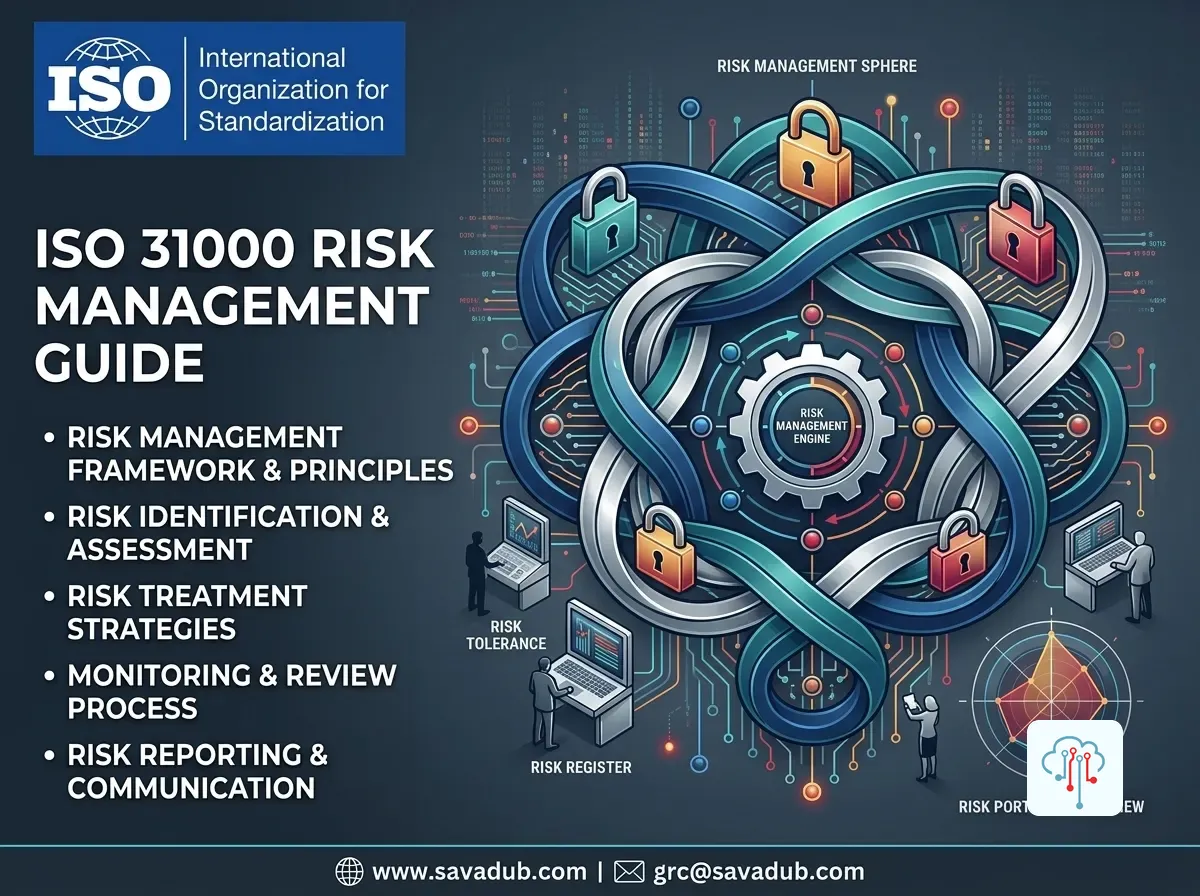
ISO 31000:2018 — Risk Management: Guidelines — is an international standard that provides principles and generic guidelines for risk management. Unlike ISO 27001 (which is certifiable), ISO 31000 is a guidance standard — it cannot be certified but it provides the conceptual and process foundation for risk management across all types of organisations and all categories of risk.
ISO 31000 covers the full spectrum of organisational risk — strategic, operational, financial, compliance, reputational, and project risk — in a unified framework. It is sector- and discipline-agnostic, making it applicable to every type and size of organisation.
Three core components:
Principles: The characteristics that make risk management effective — integration, structured and comprehensive, customised, inclusive, dynamic, available information, human and cultural factors, and continual improvement.
Framework: The leadership, governance, and organisational structures that support risk management — mandate and commitment, design, implementation, evaluation, and improvement.
Process: The operational risk management process — communication and consultation, establishing context, risk assessment (identification, analysis, evaluation), risk treatment, monitoring and review, recording and reporting.
The Risk Assessment Process: Identification, Analysis, and Evaluation
Risk Identification: Systematically identifying sources of risk, areas of impact, events, their causes and potential consequences. Techniques include brainstorming workshops, expert interviews, SWOT analysis, PESTLE analysis, cause-and-effect analysis, and process flow analysis.
Risk Analysis: Understanding the nature of risk and its characteristics including likelihood and consequence. Both qualitative (high/medium/low scales) and quantitative (probability and impact in financial terms) approaches are used depending on the availability of data and the decision context.
Risk Evaluation: Comparing risk analysis results against risk criteria (the organisation's defined risk appetite and tolerance) to determine which risks require treatment, monitoring, or acceptance. Risk evaluation feeds the prioritisation of risk treatment investment.
Key outputs: A risk register documenting identified risks, their causes, consequences, current controls, likelihood, impact, and risk level.
Risk Treatment: The Four Options
For each risk that exceeds tolerance, ISO 31000 defines four treatment options:
Avoid — discontinue the activity that gives rise to the risk. Appropriate when the risk level cannot be reduced to an acceptable level through other means and the activity is not essential to the organisation's objectives.
Modify — implement controls to reduce likelihood, consequence, or both. The most common treatment for operational and compliance risks. Controls must be proportionate to the risk level and the cost of implementation.
Transfer — shift the financial consequences to a third party (insurance, contractual transfer). Note that liability can be transferred but not accountability — transferred risk still requires monitoring.
Retain/Accept — consciously decide to accept the risk within tolerance. Appropriate for low-level risks where the cost of treatment exceeds the benefit. Requires documented rationale and periodic review.
A risk treatment plan documents the selected treatment option, the controls to be implemented, the responsible owner, the implementation timeline, and the residual risk level after treatment.
Integrating ISO 31000 with ISO 27001 and Corporate Governance
ISO 31000 and ISO 27001 complement each other directly. ISO 27001's risk assessment requirements (Clauses 6.1.2 and 6.1.3) are a specific application of the ISO 31000 risk process to information security risks. Organisations implementing both can use a single risk methodology and register — applying the ISO 31000 process at the enterprise level and the ISO 27001 risk process at the information security level.
Integration with corporate governance structures:
Board and Executive Risk Oversight: ISO 31000's framework requirements support the board-level risk oversight function — ensuring that material risks are identified, assessed, reported, and managed with appropriate executive accountability.
Risk Appetite and Tolerance: The framework requires the organisation to define its risk appetite — the amount and type of risk it is willing to take in pursuit of its objectives. This feeds both strategic decision-making and operational risk treatment prioritisation.
Risk Reporting: Regular risk reporting to leadership covering the risk landscape, changes in risk levels, treatment progress, and emerging risks. ISO 31000 provides a framework for making this reporting consistent, meaningful, and decision-relevant.
Why Organisations Choose Savadub
Deep GRC Expertise
Our team holds practitioner-level expertise across every major compliance framework — not just theoretical knowledge, but hands-on implementation experience across multiple industries and organisation sizes.
Engineers, Not Just Consultants
We implement controls, not just recommend them. Our GRC engineers configure the systems, write the integrations, and build the monitoring pipelines that make compliance operational.
Global and African Regulatory Coverage
We understand both the global frameworks and the African regulatory environment — NDPR, NDPA, CBN directives, NITDA guidelines, and regional data protection laws — making us uniquely positioned for organisations operating across Africa and internationally.
Internal and External Audit Capability
We provide both embedded internal audit functions and independent third-party audit support, including CPA-accredited audit coordination for SOC examinations.
End-to-End Engagement
From initial gap assessment through certification, continuous monitoring, and ongoing compliance management — we are your long-term GRC partner, not a one-time consultant.
Industries We Serve
Financial Services · Healthcare · Technology & SaaS · Manufacturing · Logistics & Trade · Government & Public Sector · Energy & Critical Infrastructure · Education & EdTech · Media & Broadcasting · Retail & E-Commerce · Professional Services · Food & Beverage
Deliverables You Receive
Working with Savadub, every engagement delivers a concrete set of outputs:
- Gap Assessment Report — prioritised findings with effort estimates and risk ratings
- Compliance Roadmap — milestone-based plan from current state to certification or attestation
- Risk Register — organisational risk register with treatment plans
- Policy Pack — all required policies authored, reviewed, and approved
- Technical Control Implementation Evidence — configurations, screenshots, and audit trails
- Internal Audit Report — independent assessment of control effectiveness
- Audit Evidence Repository — organised, auditor-ready evidence collection
- Executive Summary Presentation — board and leadership-ready compliance status
- Remediation Tracker — structured tracking of open findings and closure evidence
- Continuous Monitoring Setup — ongoing CCM pipeline for post-certification compliance
Get Started with Savadub
Savadub's GRC practice combines deep compliance expertise with technical engineering capability. We don't just advise — we build, implement, and operate your compliance program from the ground up.
Book a free GRC consultation with our team. We will review your current posture, identify your most critical gaps, and give you a clear, costed roadmap to compliance.
Contact us:
- Email: grc@savadub.com
- Phone: +234 816 734 2201
- WhatsApp: +234 903 234 8435
- Website: www.savadub.com