Back to Journal Application Security

DevSecOps - Embedding Security Into Your DevOps Pipeline Without Slowing Delivery

A practical guide to DevSecOps — how to integrate security tooling, processes, and culture into your CI/CD pipeline, infrastructure as code, and release process to build security at speed.
DevSecOps - Embedding Security Into Your DevOps Pipeline Without Slowing Delivery

DevSecOps: Making Security a Natural Part of How You Ship Software

DevSecOps — Development, Security, and Operations — is the practice of integrating security tools, processes, and culture into the DevOps pipeline so that security is a shared responsibility throughout the software delivery lifecycle, rather than a gate that development must pass before release. The goal is not to slow development down with security checks but to make security checks fast, automated, and invisible to the development team.


The DevSecOps Pipeline: Security at Every Stage

A mature DevSecOps pipeline integrates security controls at every stage of the development and delivery process:

IDE (Integrated Development Environment): Security plugins (Snyk IDE, SonarLint) give developers real-time feedback on security issues as they write code — the fastest and cheapest point to fix vulnerabilities.

Pre-commit hooks: Git hooks that run fast security checks (secret scanning, basic SAST) before code is committed. Tools like git-secrets, gitleaks, and talisman prevent secrets from entering the repository.

Pull request / code review: SAST tools run on every pull request, with results reviewed as part of the code review process. Security team members participate in code review for high-risk changes.

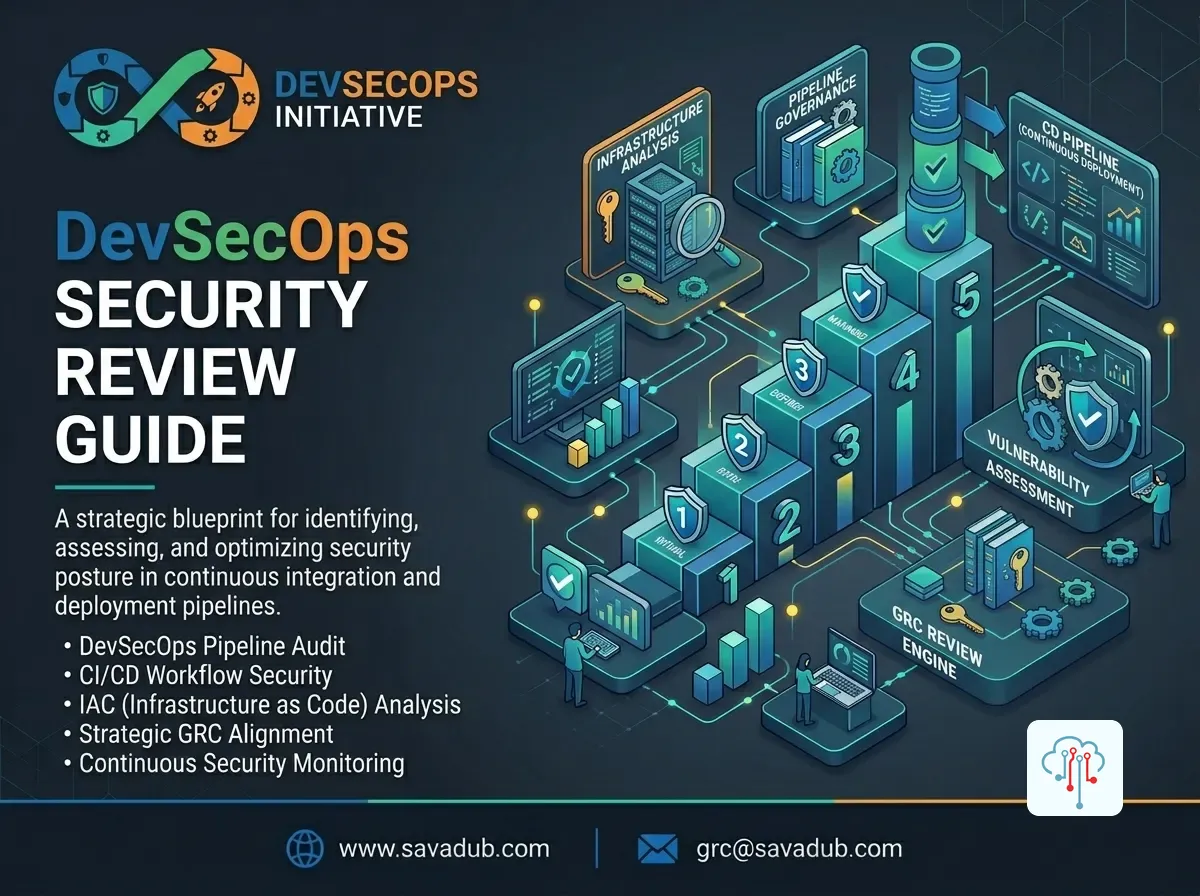
CI pipeline: Full SAST scan, SCA dependency check, container image scanning, and infrastructure as code (IaC) security scanning run in the CI pipeline on every build. Failed builds block progression to staging.

Staging / pre-production: DAST scanning of the deployed application in a staging environment. API security testing. Integration with security monitoring to capture anomalous behaviour during testing.

Production: Runtime application self-protection (RASP), continuous cloud security posture monitoring, real-time vulnerability scanning of production infrastructure, and security event logging feeding the SIEM.

Infrastructure as Code Security

When infrastructure is defined in code (Terraform, CloudFormation, Pulumi, ARM templates), security misconfigurations can be caught before deployment through IaC Security Scanning:

Tools like Checkov, Terrascan, tfsec, and KICS scan IaC files for common misconfigurations:

  • S3 buckets without encryption or public access blocking
  • Security groups with 0.0.0.0/0 on sensitive ports
  • IAM roles with wildcard permissions
  • Databases without deletion protection
  • Missing CloudTrail logging

Integrating IaC scanning into the CI pipeline means infrastructure security policies are enforced automatically — a misconfigured resource cannot be deployed to production without an explicit approval override.

Container and Kubernetes Security in DevSecOps

Container-based deployments introduce specific security considerations that DevSecOps programs must address:

Container image scanning: Scanning container images for known vulnerabilities in OS packages and application dependencies before pushing to registries. Tools: Trivy, Grype, Snyk Container, Aqua Security.

Base image hygiene: Using minimal base images (distroless, Alpine-based) to reduce the attack surface. Pinning base image versions rather than using latest.

Kubernetes security: Implementing Pod Security Standards, network policies, RBAC policies, and secrets management. Scanning Kubernetes manifests for misconfigurations (missing resource limits, privileged containers, host path mounts).

Runtime security: Monitoring container behaviour at runtime for anomalous activity — unexpected process execution, file system changes, network connections to unexpected destinations. Tools: Falco, Sysdig.

Building a DevSecOps Culture

Technology alone doesn't make DevSecOps work. The cultural elements are equally important:

Developer security training: Security awareness training tailored to developers — teaching them to recognise and avoid common vulnerability patterns in their specific language and framework.

Security champions: Embedding security-focused developers (Security Champions) in engineering teams who serve as the first point of contact for security questions and review high-risk code changes.

Blameless security postmortems: When vulnerabilities reach production, conducting blameless postmortems that focus on improving the security controls that failed to catch the issue — not on blaming the developer who introduced the vulnerability.

Security as a feature: Framing security work as feature work that improves the product, not as overhead that slows delivery. Security findings should be tracked in the same backlog as functional bugs, with priority determined by risk severity.

Why Organisations Choose Savadub

Deep GRC Expertise

Our team holds practitioner-level expertise across every major compliance framework — not just theoretical knowledge, but hands-on implementation experience across multiple industries and organisation sizes.

Engineers, Not Just Consultants

We implement controls, not just recommend them. Our GRC engineers configure the systems, write the integrations, and build the monitoring pipelines that make compliance operational.

Global and African Regulatory Coverage

We understand both the global frameworks and the African regulatory environment — NDPR, NDPA, CBN directives, NITDA guidelines, and regional data protection laws — making us uniquely positioned for organisations operating across Africa and internationally.

Internal and External Audit Capability

We provide both embedded internal audit functions and independent third-party audit support, including CPA-accredited audit coordination for SOC examinations.

End-to-End Engagement

From initial gap assessment through certification, continuous monitoring, and ongoing compliance management — we are your long-term GRC partner, not a one-time consultant.

Industries We Serve

Financial Services · Healthcare · Technology & SaaS · Manufacturing · Logistics & Trade · Government & Public Sector · Energy & Critical Infrastructure · Education & EdTech · Media & Broadcasting · Retail & E-Commerce · Professional Services · Food & Beverage

Deliverables You Receive

Working with Savadub, every engagement delivers a concrete set of outputs:

  • Gap Assessment Report — prioritised findings with effort estimates and risk ratings
  • Compliance Roadmap — milestone-based plan from current state to certification or attestation
  • Risk Register — organisational risk register with treatment plans
  • Policy Pack — all required policies authored, reviewed, and approved
  • Technical Control Implementation Evidence — configurations, screenshots, and audit trails
  • Internal Audit Report — independent assessment of control effectiveness
  • Audit Evidence Repository — organised, auditor-ready evidence collection
  • Executive Summary Presentation — board and leadership-ready compliance status
  • Remediation Tracker — structured tracking of open findings and closure evidence
  • Continuous Monitoring Setup — ongoing CCM pipeline for post-certification compliance

Get Started with Savadub

Savadub's GRC practice combines deep compliance expertise with technical engineering capability. We don't just advise — we build, implement, and operate your compliance program from the ground up.

Book a free GRC consultation with our team. We will review your current posture, identify your most critical gaps, and give you a clear, costed roadmap to compliance.

Contact us:

  • Email: grc@savadub.com
  • Phone: +234 816 734 2201
  • WhatsApp: +234 903 234 8435
  • Website: www.savadub.com

Share this story