Back to Journal NIST Standards

NIST SP 800-53 Rev 5 - The Complete Guide to Federal Security and Privacy Controls

An in-depth guide to NIST SP 800-53 Revision 5 — the 20 control families, how to select and tailor control baselines, how to implement the most critical controls, and how SP 800-53 relates to FedRAMP, FISMA, and CMMC.
NIST SP 800-53 Rev 5 - The Complete Guide to Federal Security and Privacy Controls

NIST SP 800-53 Rev 5: Understanding and Implementing Federal Security and Privacy Controls

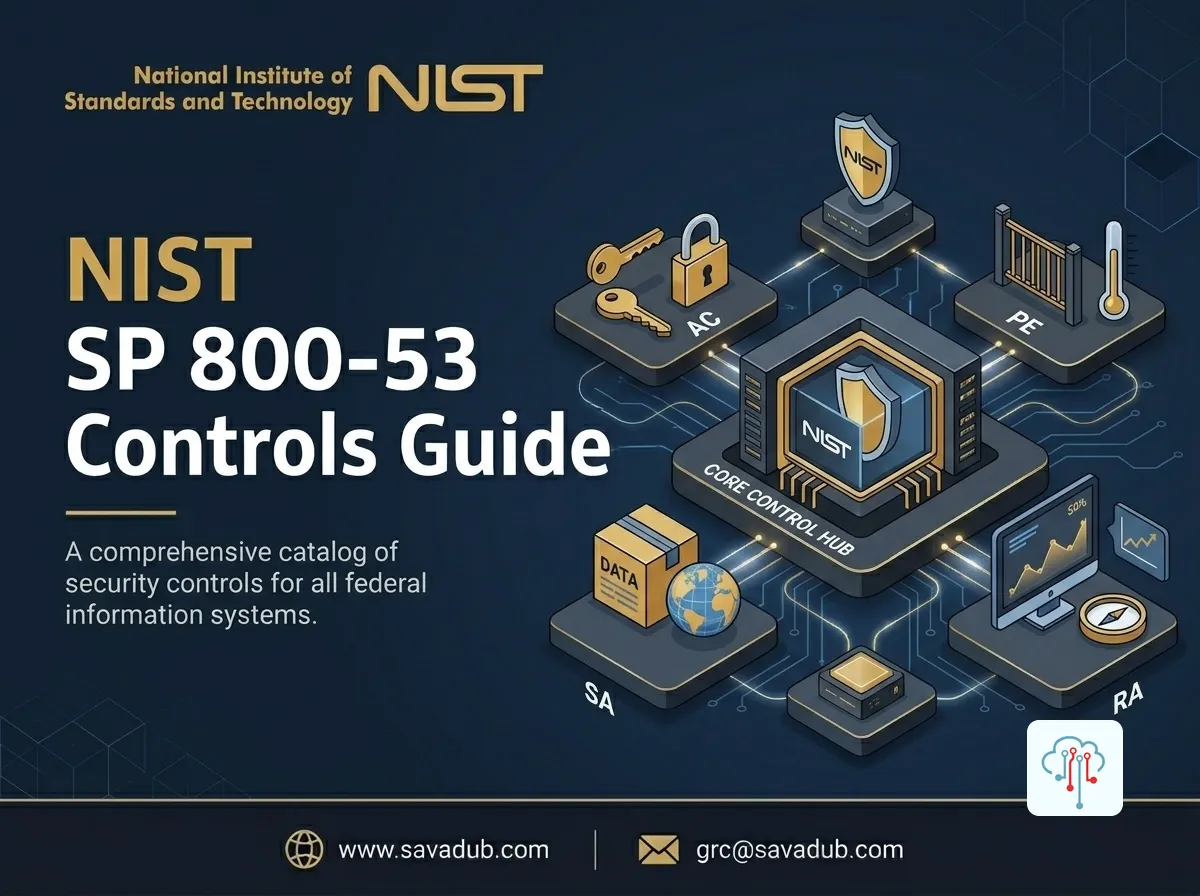
NIST Special Publication 800-53 Revision 5 is the most comprehensive catalogue of security and privacy controls in existence. With over 1,000 individual controls and control enhancements organised across 20 control families, SP 800-53 serves as the definitive reference for information security control selection and implementation for US federal agencies, government contractors, FedRAMP cloud providers, and any organisation seeking a rigorous, comprehensive approach to security controls.


The 20 Control Families

SP 800-53 Rev 5 organises controls into 20 families, each identified by a two-letter acronym:

AC — Access Control: User accounts, roles, privileges, remote access, information flow enforcement, separation of duties.

AT — Awareness and Training: Security awareness, role-based training, insider threat awareness.

AU — Audit and Accountability: Event logging, audit record content, protection of audit information, audit review and reporting.

CA — Assessment, Authorisation, and Monitoring: Security assessments, plan of action and milestones, system authorisation, continuous monitoring.

CM — Configuration Management: Baseline configurations, configuration change control, security impact analysis, user-installed software.

CP — Contingency Planning: Business continuity, disaster recovery, backup, system recovery and reconstitution.

IA — Identification and Authentication: User identification, authentication management, multi-factor authentication, device identification.

IR — Incident Response: Incident handling, incident monitoring, incident reporting, incident response assistance.

MA — Maintenance: System maintenance, controlled maintenance tools, remote maintenance.

MP — Media Protection: Media access, media sanitisation, media transport, media use.

PE — Physical and Environmental Protection: Physical access authorisations, visitor control, emergency power, fire protection.

PL — Planning: System security plan, rules of behaviour, privacy impact assessment.

PM — Program Management: Enterprise-level program controls covering risk management, insider threat program, critical infrastructure plan.

PS — Personnel Security: Position risk designation, personnel screening, termination and transfer, access agreements.

PT — Personally Identifiable Information Processing and Transparency: Privacy controls covering PII processing, consent, privacy notices, data quality.

RA — Risk Assessment: Risk assessment, vulnerability monitoring and scanning, criticality analysis.

SA — System and Services Acquisition: Acquisition process, system development lifecycle, supply chain risk management.

SC — System and Communications Protection: Network segmentation, denial-of-service protection, cryptographic key management, transmission integrity and confidentiality.

SI — System and Information Integrity: Policy and procedures, flaw remediation, malicious code protection, information system monitoring, security alerts.

SR — Supply Chain Risk Management: Supply chain risk plan, acquisition strategies, supply chain controls, notification agreements.

Control Baselines: Low, Moderate, and High

SP 800-53 provides three control baselines corresponding to FIPS 199 impact levels:

Low baseline: The minimum security controls appropriate for systems where a security breach would have limited adverse effect on operations, assets, or individuals.

Moderate baseline: Controls for systems where a breach would have serious adverse effects. The most widely applied baseline — used for the majority of federal systems and as the basis for FedRAMP Moderate.

High baseline: The most extensive control set, for systems where a breach would have severe or catastrophic consequences — national security systems, systems processing sensitive personal data at scale, critical infrastructure control systems.

Tailoring: Baselines are starting points, not final selections. Organisations tailor baselines by adding controls (for organisation-specific risks), removing controls (with documented justification where a control is not applicable), providing compensating controls (where the baseline control cannot be implemented), and adding control parameter values specific to their environment.

The Most Critical SP 800-53 Control Areas

Multi-Factor Authentication (IA-2): One of the most universally impactful controls. Requiring MFA for all privileged access, and for all remote access, eliminates a significant category of credential-based attack vectors. Implementing MFA across all in-scope accounts is typically the highest-priority technical control in any SP 800-53 implementation.

Least Privilege (AC-6): Restricting access to only the capabilities necessary for each role. Implementing least privilege reduces the blast radius of any compromised account or insider threat scenario.

Audit Logging (AU-2, AU-3, AU-12): Comprehensive logging of security-relevant events, with sufficient detail to support incident investigation and forensic analysis. Log centralisation and protection against tampering are critical supporting controls.

Configuration Management (CM-2, CM-3, CM-6): Baseline configurations for all system components, change control processes, and security configuration settings. Configuration drift is one of the leading causes of security vulnerabilities in complex environments.

Incident Response (IR-4, IR-6, IR-8): Documented, tested incident response capability including detection, containment, eradication, recovery, and post-incident reporting. The ability to respond effectively to incidents is as important as preventing them.

SP 800-53 and Commercial Organisations

While SP 800-53 was developed for federal systems, it has become widely used in the commercial sector because of its comprehensiveness and credibility:

FedRAMP cloud providers must implement SP 800-53 Moderate or High baselines as part of their FedRAMP authorisation — making SP 800-53 knowledge essential for any cloud provider targeting the US federal market.

DoD contractors must implement NIST SP 800-171 for CUI systems — 110 requirements that are a subset of SP 800-53 controls, with the same control logic and implementation patterns.

Enterprise security programs increasingly use SP 800-53 as a comprehensive control catalogue, selecting applicable controls based on their specific risk profile rather than applying the full federal baseline.

Security assessors and penetration testers use SP 800-53 as a reference for evaluating the completeness and appropriateness of security control implementations.

Why Organisations Choose Savadub

Deep GRC Expertise

Our team holds practitioner-level expertise across every major compliance framework — not just theoretical knowledge, but hands-on implementation experience across multiple industries and organisation sizes.

Engineers, Not Just Consultants

We implement controls, not just recommend them. Our GRC engineers configure the systems, write the integrations, and build the monitoring pipelines that make compliance operational.

Global and African Regulatory Coverage

We understand both the global frameworks and the African regulatory environment — NDPR, NDPA, CBN directives, NITDA guidelines, and regional data protection laws — making us uniquely positioned for organisations operating across Africa and internationally.

Internal and External Audit Capability

We provide both embedded internal audit functions and independent third-party audit support, including CPA-accredited audit coordination for SOC examinations.

End-to-End Engagement

From initial gap assessment through certification, continuous monitoring, and ongoing compliance management — we are your long-term GRC partner, not a one-time consultant.

Industries We Serve

Financial Services · Healthcare · Technology & SaaS · Manufacturing · Logistics & Trade · Government & Public Sector · Energy & Critical Infrastructure · Education & EdTech · Media & Broadcasting · Retail & E-Commerce · Professional Services · Food & Beverage

Deliverables You Receive

Working with Savadub, every engagement delivers a concrete set of outputs:

  • Gap Assessment Report — prioritised findings with effort estimates and risk ratings
  • Compliance Roadmap — milestone-based plan from current state to certification or attestation
  • Risk Register — organisational risk register with treatment plans
  • Policy Pack — all required policies authored, reviewed, and approved
  • Technical Control Implementation Evidence — configurations, screenshots, and audit trails
  • Internal Audit Report — independent assessment of control effectiveness
  • Audit Evidence Repository — organised, auditor-ready evidence collection
  • Executive Summary Presentation — board and leadership-ready compliance status
  • Remediation Tracker — structured tracking of open findings and closure evidence
  • Continuous Monitoring Setup — ongoing CCM pipeline for post-certification compliance

Get Started with Savadub

Savadub's GRC practice combines deep compliance expertise with technical engineering capability. We don't just advise — we build, implement, and operate your compliance program from the ground up.

Book a free GRC consultation with our team. We will review your current posture, identify your most critical gaps, and give you a clear, costed roadmap to compliance.

Contact us:

  • Email: grc@savadub.com
  • Phone: +234 816 734 2201
  • WhatsApp: +234 903 234 8435
  • Website: www.savadub.com

Share this story