Back to Journal ISO Standards

ISO 22301 - Building a Certified Business Continuity Management System

A complete guide to ISO 22301, the international standard for business continuity management. Learn how to build a BCMS, conduct BIA, develop recovery plans, and achieve certification that satisfies regulators and enterprise buyers.
ISO 22301 - Building a Certified Business Continuity Management System

ISO 22301: Business Continuity Management — From BIA to Certification

Every organisation faces disruptions — cyber incidents, power outages, natural disasters, pandemics, supply chain failures. The question is not whether disruption will occur but whether your organisation is prepared to respond, recover, and resume critical operations within the timeframes that your customers, regulators, and business viability require. ISO 22301:2019 is the international standard for building and certifying that capability.


What Is ISO 22301

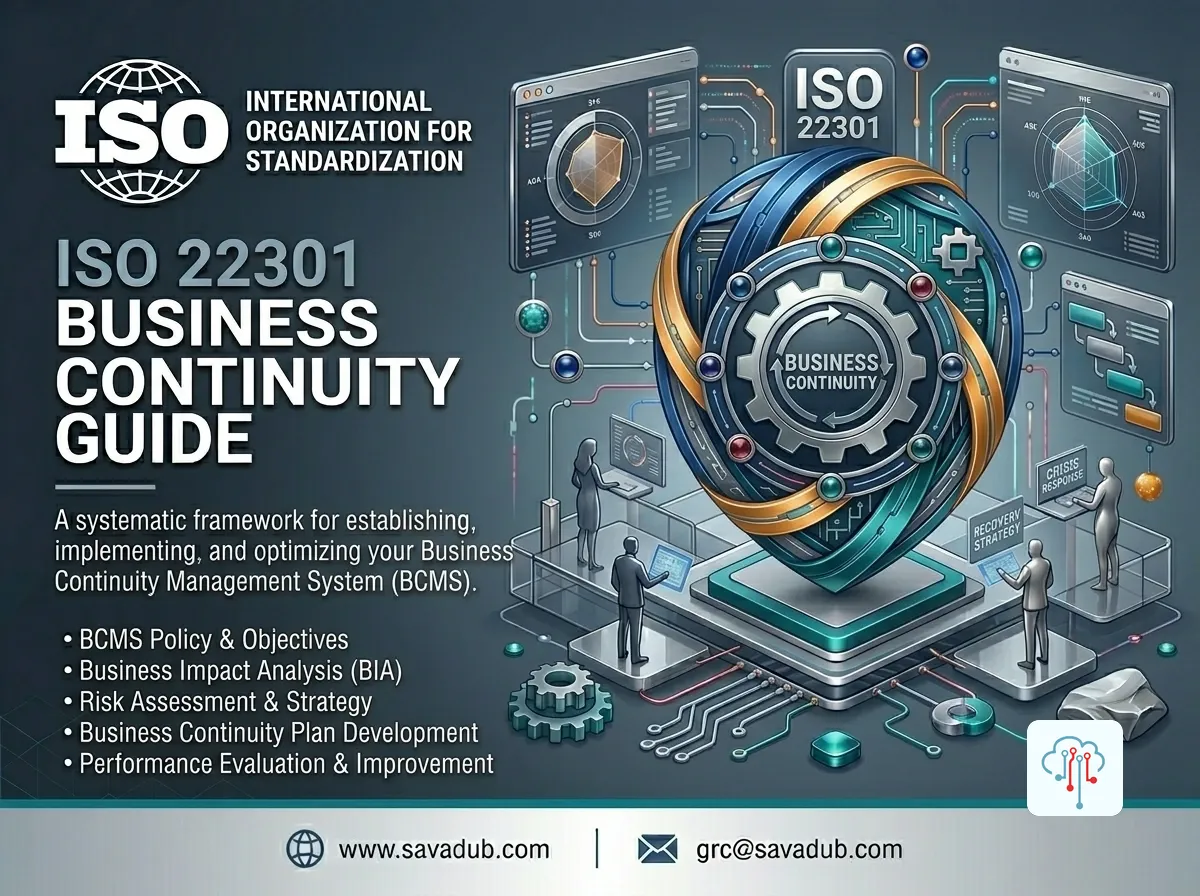
ISO 22301:2019 specifies requirements for a Business Continuity Management System (BCMS) — a systematic framework for identifying threats to your organisation, understanding their impact on business operations, and building resilience capabilities that enable effective response and recovery.

ISO 22301 follows the same high-level structure as ISO 27001 (Plan-Do-Check-Act, Clauses 4–10), making it straightforward to integrate with an existing ISO 27001 ISMS as a complementary management system. Many organisations pursue both certifications simultaneously, sharing context, leadership, and governance infrastructure.

Key outputs of an ISO 22301 BCMS:

  • Business Impact Analysis (BIA) — identifying critical functions, their dependencies, and the impact of disruption over time
  • Recovery Time Objectives (RTOs) — maximum tolerable downtime for each critical function
  • Recovery Point Objectives (RPOs) — maximum tolerable data loss for each critical system
  • Business Continuity Plans (BCPs) — documented, tested procedures for responding to and recovering from disruptions
  • Incident Response Plans — immediate response procedures for specific threat scenarios
  • Crisis Communication Plans — stakeholder communication during and after disruptions
  • Exercise and Testing Programme — regular testing that confirms recovery plans work as designed

The Business Impact Analysis: The Foundation of ISO 22301

The BIA is the cornerstone of the BCMS. It systematically identifies which functions, processes, and systems are critical to your organisation's operation and mission — and what the consequences of their disruption are over time.

Identifying critical activities: Working with department heads and process owners to catalogue all business activities and assess their criticality. Not all activities are equally critical — a payroll run that happens monthly is less time-sensitive than a payment processing system that runs continuously.

Assessing financial impact: Quantifying the financial cost of disruption for critical activities — lost revenue, penalties, recovery costs, regulatory fines. This helps prioritise investment in continuity controls.

Assessing non-financial impact: Regulatory impact (regulators that must be notified), reputational impact (customer and media attention), operational impact (knock-on effects on other activities), and strategic impact.

Identifying dependencies: Understanding the internal dependencies (systems, people, facilities) and external dependencies (suppliers, utilities, cloud providers) that each critical activity relies upon.

Establishing RTOs and RPOs: Based on the impact assessment, defining the maximum tolerable downtime and data loss for each critical activity. These drive the design of recovery strategies and investments.

Building Business Continuity Plans That Actually Work

A business continuity plan that has never been tested is a document, not a capability. ISO 22301 requires not just the development of plans but their regular testing and improvement.

Plan structure: Each BCP should cover the trigger conditions for activation, the immediate response actions (first 30 minutes), the stabilisation phase (first four hours), the recovery phase (hours to days), and the restoration phase (returning to normal operations).

Roles and responsibilities: Every action in a BCP must have a named owner and a backup owner. Plans that reference roles without naming individuals are difficult to execute under pressure.

Communication procedures: Who communicates what to whom — employees, customers, regulators, media, board — during a disruption. Pre-drafted communication templates for common scenarios save critical time.

Testing and exercises: ISO 22301 requires regular testing of BCPs. Testing types range from desktop exercises (tabletop discussion of scenarios) through walkthrough exercises (teams walk through their BCP responses) to full simulation exercises (live activation of recovery procedures with actual systems).

ISO 22301 and Regulatory Resilience Requirements

ISO 22301 certification is increasingly required or recognised by regulators across multiple sectors:

Financial services: Central banks and financial regulators in many jurisdictions require licensed financial institutions to demonstrate operational resilience — the ability to remain within impact tolerances during severe but plausible disruption scenarios. ISO 22301 provides a credible framework for demonstrating this capability.

Healthcare: Health authorities require healthcare providers and health technology companies to maintain service continuity for patient safety. ISO 22301 provides the structured approach regulators expect.

Critical infrastructure: Energy, telecoms, water, and transport regulators increasingly mandate formal business continuity programs. ISO 22301 certification provides independent verification of program maturity.

Enterprise supply chains: Large enterprises routinely require their critical suppliers to maintain ISO 22301 certification or equivalent BCP programs, particularly post-COVID where supply chain resilience failures became boardroom issues.

Why Organisations Choose Savadub

Deep GRC Expertise

Our team holds practitioner-level expertise across every major compliance framework — not just theoretical knowledge, but hands-on implementation experience across multiple industries and organisation sizes.

Engineers, Not Just Consultants

We implement controls, not just recommend them. Our GRC engineers configure the systems, write the integrations, and build the monitoring pipelines that make compliance operational.

Global and African Regulatory Coverage

We understand both the global frameworks and the African regulatory environment — NDPR, NDPA, CBN directives, NITDA guidelines, and regional data protection laws — making us uniquely positioned for organisations operating across Africa and internationally.

Internal and External Audit Capability

We provide both embedded internal audit functions and independent third-party audit support, including CPA-accredited audit coordination for SOC examinations.

End-to-End Engagement

From initial gap assessment through certification, continuous monitoring, and ongoing compliance management — we are your long-term GRC partner, not a one-time consultant.

Industries We Serve

Financial Services · Healthcare · Technology & SaaS · Manufacturing · Logistics & Trade · Government & Public Sector · Energy & Critical Infrastructure · Education & EdTech · Media & Broadcasting · Retail & E-Commerce · Professional Services · Food & Beverage

Deliverables You Receive

Working with Savadub, every engagement delivers a concrete set of outputs:

  • Gap Assessment Report — prioritised findings with effort estimates and risk ratings
  • Compliance Roadmap — milestone-based plan from current state to certification or attestation
  • Risk Register — organisational risk register with treatment plans
  • Policy Pack — all required policies authored, reviewed, and approved
  • Technical Control Implementation Evidence — configurations, screenshots, and audit trails
  • Internal Audit Report — independent assessment of control effectiveness
  • Audit Evidence Repository — organised, auditor-ready evidence collection
  • Executive Summary Presentation — board and leadership-ready compliance status
  • Remediation Tracker — structured tracking of open findings and closure evidence
  • Continuous Monitoring Setup — ongoing CCM pipeline for post-certification compliance

Get Started with Savadub

Savadub's GRC practice combines deep compliance expertise with technical engineering capability. We don't just advise — we build, implement, and operate your compliance program from the ground up.

Book a free GRC consultation with our team. We will review your current posture, identify your most critical gaps, and give you a clear, costed roadmap to compliance.

Contact us:

  • Email: grc@savadub.com
  • Phone: +234 816 734 2201
  • WhatsApp: +234 903 234 8435
  • Website: www.savadub.com

Share this story