HIPAA Compliance: Protecting Patient Data and Satisfying Federal Healthcare Privacy Law
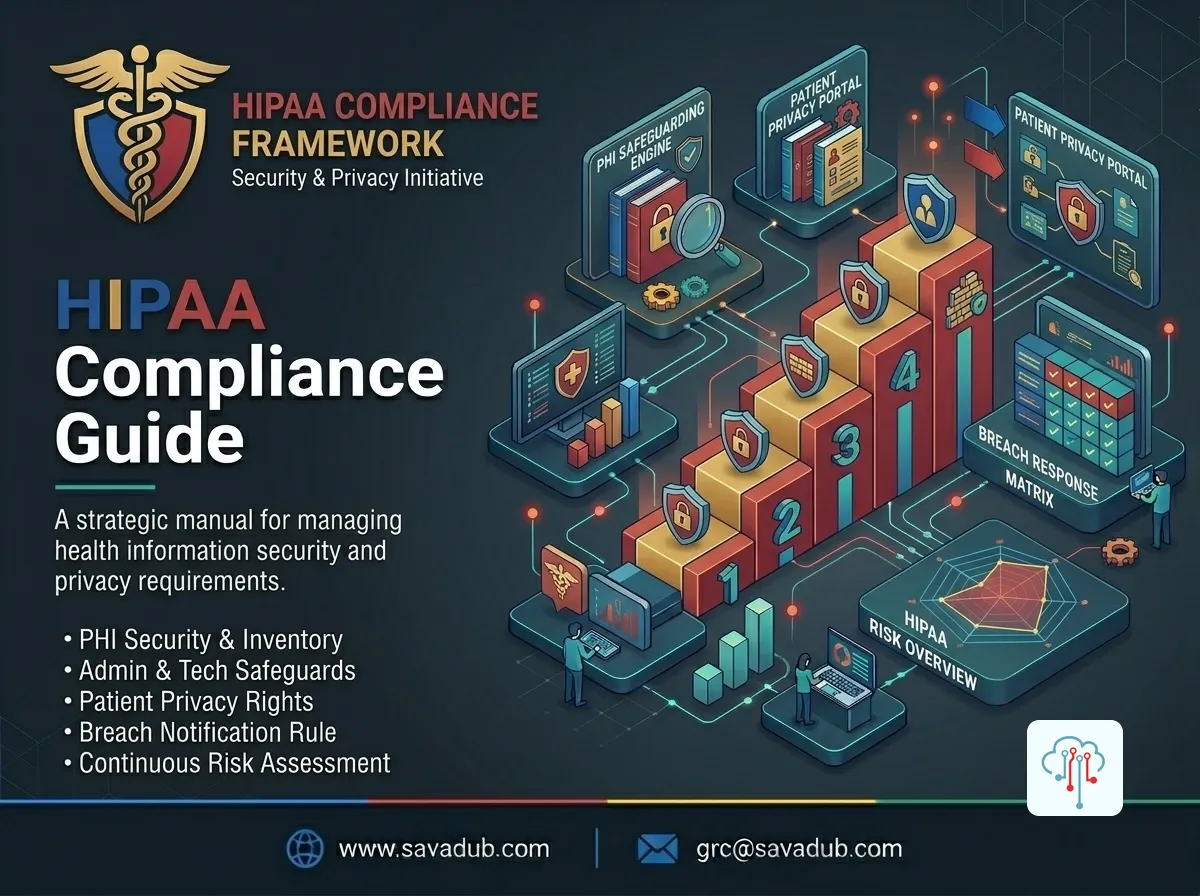
The Health Insurance Portability and Accountability Act (HIPAA) is the United States' primary federal healthcare privacy and security law. For covered entities — hospitals, clinics, health plans, and healthcare clearinghouses — and their business associates, HIPAA creates mandatory obligations for protecting Protected Health Information (PHI) that carry significant civil and criminal penalties for violations. Understanding and implementing HIPAA requirements is non-negotiable for any organisation in the US healthcare ecosystem.
HIPAA's Three Key Rules
The Privacy Rule: Establishes national standards for the protection of PHI. Defines permitted uses and disclosures of PHI, patient rights with respect to their health information, and the administrative requirements covered entities must implement. Key provisions include: patients' right to access their PHI, the minimum necessary standard (only access and disclose what is needed), and restrictions on selling PHI or using it for marketing without authorisation.
The Security Rule: Establishes standards for protecting electronic PHI (ePHI). Organised into three safeguard categories:
Administrative safeguards: Security management process (risk analysis, risk management, sanction policy, information system activity review), assigned security responsibility, workforce security, information access management, security awareness and training, security incident procedures, contingency plan, and evaluation.
Physical safeguards: Facility access controls, workstation use and security, device and media controls.
Technical safeguards: Access control (unique user identification, emergency access procedure, automatic logoff, encryption and decryption), audit controls, integrity controls, and transmission security (encryption in transit).
The Breach Notification Rule: Requires covered entities to notify affected individuals, the Secretary of HHS, and (in some cases) the media when there is a breach of unsecured PHI. Notification to affected individuals and HHS must occur within 60 days of discovery of the breach. Breaches affecting 500 or more individuals in a state must also be reported to prominent media outlets.
The Risk Analysis: The Foundation of HIPAA Security
The HIPAA Security Rule requires covered entities and business associates to conduct a comprehensive and accurate risk analysis as the foundation of their security compliance. A HIPAA risk analysis:
- Identifies the scope of ePHI — all ePHI created, received, maintained, or transmitted
- Identifies potential threats and vulnerabilities to ePHI
- Assesses current security measures
- Determines the likelihood of threat occurrence
- Determines the potential impact of threat occurrence
- Assigns risk levels to each threat/vulnerability combination
- Documents the risk analysis
The risk analysis must be current — it must be reviewed and updated whenever there are environmental or operational changes, new threats emerge, or a security incident occurs. An undocumented or outdated risk analysis is one of the most common findings in HHS OCR enforcement actions.
Business Associate Agreements: Extending HIPAA to the Supply Chain
Business Associates — any person or entity that creates, receives, maintains, or transmits ePHI on behalf of a covered entity — must sign a Business Associate Agreement (BAA) with the covered entity before receiving any PHI.
BAA requirements include:
- The BA will only use or disclose PHI as permitted or required by the BAA or required by law
- The BA will implement appropriate safeguards to prevent unauthorised use or disclosure
- The BA will report any breach of PHI to the covered entity
- The BA will ensure that sub-contractors who receive PHI sign BAAs
- At termination, the BA will return or destroy all PHI
Common business associates include: cloud storage providers, EHR vendors, billing services, IT managed service providers, data analytics platforms, transcription services, and lawyers handling PHI.
Covered entities must identify all business associates, execute BAAs, and conduct periodic assessments to verify that BAs are meeting their HIPAA obligations.
HIPAA Technical Safeguard Implementation
Access control: Implement unique user IDs for all PHI system access. No shared credentials. Emergency access procedures documented and tested. Automatic logoff after defined inactivity period. Encryption for ePHI on portable devices.
Audit controls: Implement logging for all systems containing ePHI. Log logins, access to records, and changes to PHI. Review audit logs regularly and investigate anomalies.
Integrity: Implement controls to protect ePHI from improper alteration or destruction. Error-correcting memory, file integrity monitoring for systems containing PHI, digital signatures for electronic documents.
Transmission security: Encrypt all ePHI in transit using TLS 1.2 or 1.3. Implement end-to-end encryption for ePHI transmitted over open networks. Verify recipient identity before transmitting PHI.
Encryption and decryption: The Security Rule includes encryption as an 'addressable' safeguard — meaning organisations must either implement it or document why it is not reasonable and appropriate and implement an equivalent alternative. In practice, not encrypting ePHI is extremely difficult to justify — HHS OCR almost always considers encryption appropriate, and lack of encryption is a significant factor in breach penalty calculations.
Why Organisations Choose Savadub
Deep GRC Expertise
Our team holds practitioner-level expertise across every major compliance framework — not just theoretical knowledge, but hands-on implementation experience across multiple industries and organisation sizes.
Engineers, Not Just Consultants
We implement controls, not just recommend them. Our GRC engineers configure the systems, write the integrations, and build the monitoring pipelines that make compliance operational.
Global and African Regulatory Coverage
We understand both the global frameworks and the African regulatory environment — NDPR, NDPA, CBN directives, NITDA guidelines, and regional data protection laws — making us uniquely positioned for organisations operating across Africa and internationally.
Internal and External Audit Capability
We provide both embedded internal audit functions and independent third-party audit support, including CPA-accredited audit coordination for SOC examinations.
End-to-End Engagement
From initial gap assessment through certification, continuous monitoring, and ongoing compliance management — we are your long-term GRC partner, not a one-time consultant.
Industries We Serve
Financial Services · Healthcare · Technology & SaaS · Manufacturing · Logistics & Trade · Government & Public Sector · Energy & Critical Infrastructure · Education & EdTech · Media & Broadcasting · Retail & E-Commerce · Professional Services · Food & Beverage
Deliverables You Receive
Working with Savadub, every engagement delivers a concrete set of outputs:
- Gap Assessment Report — prioritised findings with effort estimates and risk ratings
- Compliance Roadmap — milestone-based plan from current state to certification or attestation
- Risk Register — organisational risk register with treatment plans
- Policy Pack — all required policies authored, reviewed, and approved
- Technical Control Implementation Evidence — configurations, screenshots, and audit trails
- Internal Audit Report — independent assessment of control effectiveness
- Audit Evidence Repository — organised, auditor-ready evidence collection
- Executive Summary Presentation — board and leadership-ready compliance status
- Remediation Tracker — structured tracking of open findings and closure evidence
- Continuous Monitoring Setup — ongoing CCM pipeline for post-certification compliance
Get Started with Savadub
Savadub's GRC practice combines deep compliance expertise with technical engineering capability. We don't just advise — we build, implement, and operate your compliance program from the ground up.
Book a free GRC consultation with our team. We will review your current posture, identify your most critical gaps, and give you a clear, costed roadmap to compliance.
Contact us:
- Email: grc@savadub.com
- Phone: +234 816 734 2201
- WhatsApp: +234 903 234 8435
- Website: www.savadub.com