Cybersecurity Maturity Assessment: Your Roadmap from Vulnerability to Resilience
A cybersecurity maturity assessment answers three questions that every security leader and board member needs: Where are we now? Where do we need to be? What will it take to get there? Without a structured maturity assessment, organisations make security investment decisions based on gut feel and vendor recommendations rather than evidence. With one, they have a fact-based, prioritised roadmap for building security capability that is proportionate to their actual risk exposure.
What a Cybersecurity Maturity Assessment Measures
A cybersecurity maturity assessment evaluates the organisation's capabilities across all major security domains:
Governance and strategy: Leadership commitment to cybersecurity, risk management programme, policy framework, security roles and accountabilities, board reporting.
Asset management: Inventory of hardware assets, software assets, data assets, and cloud resources. Understanding of data flows and system dependencies.
Identity and access management: User provisioning and deprovisioning, privileged access management, MFA coverage, access reviews, identity governance.
Network and infrastructure security: Network segmentation, firewall management, remote access controls, wireless security, DMZ design.
Endpoint security: Endpoint protection platform (EPP/EDR) coverage, patch management, device compliance policies, mobile device management.
Application security: Secure SDLC maturity, vulnerability scanning, third-party software management, web application firewall.
Data security: Data classification, encryption at rest and in transit, DLP controls, data retention and deletion.
Security operations: SIEM/SOC capability, threat detection coverage, mean time to detect (MTTD) and mean time to respond (MTTR).
Incident response: IR plan maturity, IR team capability, tabletop exercise frequency, breach notification readiness.
Third-party risk management: Vendor assessment programme, contractual security requirements, ongoing vendor monitoring.
Business continuity and resilience: BCP/DR plan maturity, RTO/RPO definitions, test frequency and coverage.
Maturity Levels: From Ad Hoc to Optimised
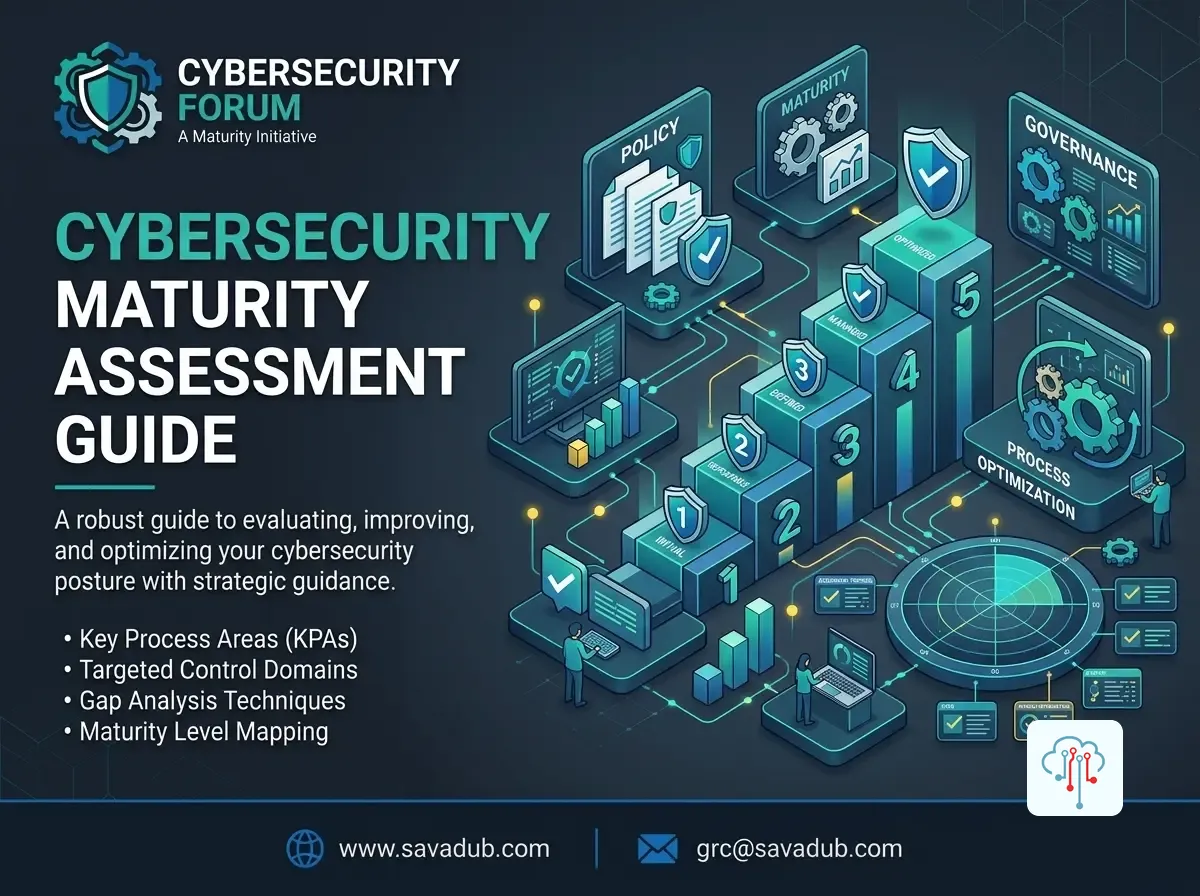
Most cybersecurity maturity models use a five-level scale:
Level 1 — Initial (Ad Hoc): Security practices are undocumented, inconsistent, and reactive. Outcomes depend on individual heroics rather than systematic processes. No formal governance.
Level 2 — Developing (Managed): Basic security processes exist but are not consistently applied. Some documentation exists. Security is largely reactive but there is awareness of the need for improvement.
Level 3 — Defined (Standardised): Security processes are documented, standardised, and consistently applied across the organisation. Governance structures exist. Risk management is practiced systematically.
Level 4 — Measured (Quantified): Security programme performance is measured and managed using quantitative methods. Metrics drive improvement decisions. Trends are tracked and reported to leadership.
Level 5 — Optimised (Continuous Improvement): Continuous improvement is embedded in security processes. The programme adapts proactively to the evolving threat landscape. Advanced detection and response capabilities. Security is genuinely integrated into business processes.
From Assessment to Roadmap: Prioritising Improvements
The assessment output is a current-state profile — a maturity score for each domain assessed. The roadmap is built by:
Defining the target state: Based on the organisation's industry, risk appetite, regulatory environment, and threat landscape, defining the target maturity level for each domain. Not all domains need to reach Level 5 — the target should be proportionate to the risk.
Gap prioritisation: Ranking gaps by their contribution to risk reduction and by the effort required to close them. Quick wins — high-impact gaps that can be closed quickly — should be addressed first.
Investment planning: Translating maturity improvements into specific projects, tools, and headcount requirements with cost estimates. This becomes the basis for security budget requests.
Board reporting: Presenting the current state, target state, and improvement roadmap to the board using business language — risk levels, potential impact of improvement, and investment required.
Why Organisations Choose Savadub
Deep GRC Expertise
Our team holds practitioner-level expertise across every major compliance framework — not just theoretical knowledge, but hands-on implementation experience across multiple industries and organisation sizes.
Engineers, Not Just Consultants
We implement controls, not just recommend them. Our GRC engineers configure the systems, write the integrations, and build the monitoring pipelines that make compliance operational.
Global and African Regulatory Coverage
We understand both the global frameworks and the African regulatory environment — NDPR, NDPA, CBN directives, NITDA guidelines, and regional data protection laws — making us uniquely positioned for organisations operating across Africa and internationally.
Internal and External Audit Capability
We provide both embedded internal audit functions and independent third-party audit support, including CPA-accredited audit coordination for SOC examinations.
End-to-End Engagement
From initial gap assessment through certification, continuous monitoring, and ongoing compliance management — we are your long-term GRC partner, not a one-time consultant.
Industries We Serve
Financial Services · Healthcare · Technology & SaaS · Manufacturing · Logistics & Trade · Government & Public Sector · Energy & Critical Infrastructure · Education & EdTech · Media & Broadcasting · Retail & E-Commerce · Professional Services · Food & Beverage
Deliverables You Receive
Working with Savadub, every engagement delivers a concrete set of outputs:
- Gap Assessment Report — prioritised findings with effort estimates and risk ratings
- Compliance Roadmap — milestone-based plan from current state to certification or attestation
- Risk Register — organisational risk register with treatment plans
- Policy Pack — all required policies authored, reviewed, and approved
- Technical Control Implementation Evidence — configurations, screenshots, and audit trails
- Internal Audit Report — independent assessment of control effectiveness
- Audit Evidence Repository — organised, auditor-ready evidence collection
- Executive Summary Presentation — board and leadership-ready compliance status
- Remediation Tracker — structured tracking of open findings and closure evidence
- Continuous Monitoring Setup — ongoing CCM pipeline for post-certification compliance
Get Started with Savadub
Savadub's GRC practice combines deep compliance expertise with technical engineering capability. We don't just advise — we build, implement, and operate your compliance program from the ground up.
Book a free GRC consultation with our team. We will review your current posture, identify your most critical gaps, and give you a clear, costed roadmap to compliance.
Contact us:
- Email: grc@savadub.com
- Phone: +234 816 734 2201
- WhatsApp: +234 903 234 8435
- Website: www.savadub.com